
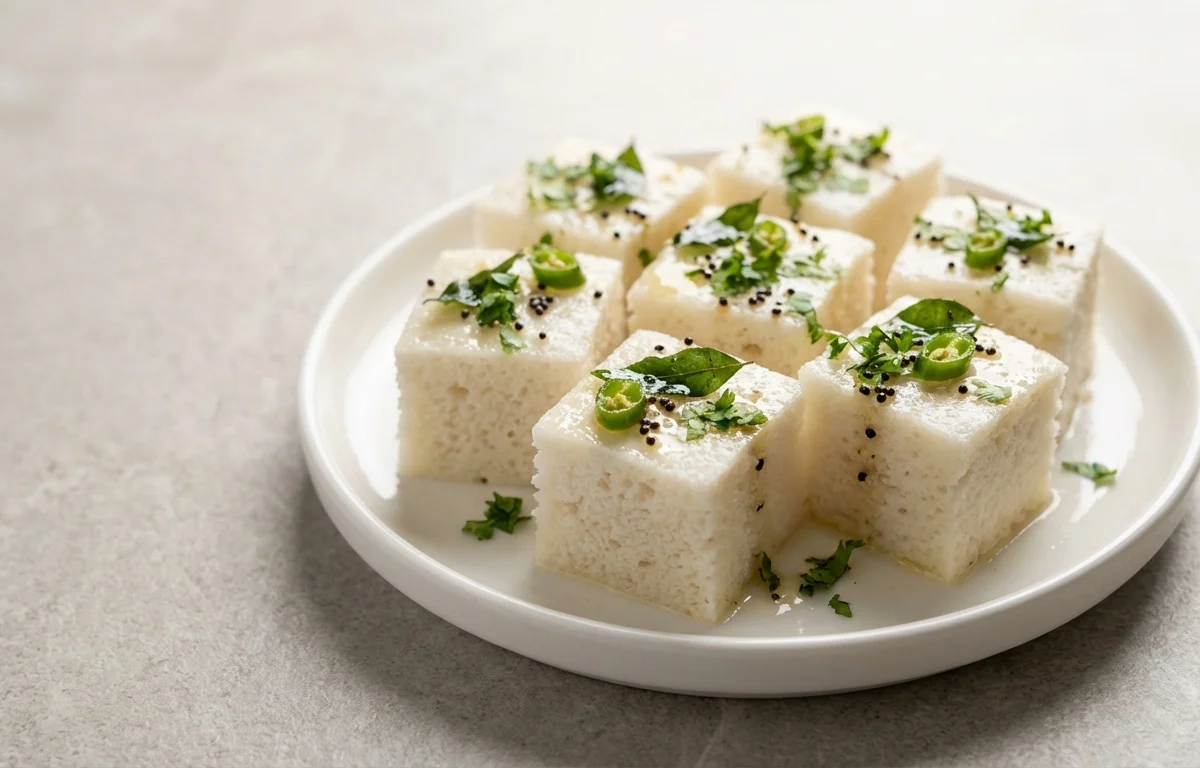
White Dhokla
A classic Gujarati delicacy, White Dhokla (or Khatta Dhokla) is a soft, spongy, and tangy steamed cake. Made from a naturally fermented batter of rice and lentils, it's a light, healthy, and gluten-free snack, traditionally served with a drizzle of aromatic tempering and green chutney.
For 4 servings
Soak the Grains (4-5 hours)
- Rinse rice and urad dal separately until water runs clear. In a large bowl, combine the rinsed rice and urad dal.
- Add enough water to cover them by at least 2 inches. Let them soak for 4-5 hours.
- Soak the poha in a separate small bowl with just enough water to cover it for 15 minutes before you plan to grind.
Grind the Batter (15 minutes)
- Drain the soaking water from the rice and dal mixture. Transfer this mixture and the soaked poha to a high-speed blender or wet grinder.
- Add about 3/4 to 1 cup of fresh water and grind to a smooth, yet slightly grainy batter (like fine semolina).
- The batter should be thick and pourable, similar to idli batter. Avoid making it too watery.
Ferment the Batter (8-12 hours)
- Transfer the batter to a large bowl, ensuring it's only half-full to allow space for rising.
- Add the sour curd and salt. Mix thoroughly with your clean hands for a minute; this helps kickstart the fermentation process.
- Cover the bowl with a lid and place it in a warm, draft-free place (like inside a turned-off oven with the light on) to ferment for 8-12 hours, or overnight.
- The batter is ready when it has risen, appears airy, and has a pleasant sour aroma.
Prepare for Steaming (5 minutes)
- Once fermented, gently stir the batter a few times. Do not overmix, as this will deflate the air pockets.
- Stir in the ginger and green chili paste.
- Grease an 8-inch round pan or a dhokla plate with a little oil.
- Add 1.5 to 2 inches of water to a steamer or a large pot and bring it to a rolling boil.
Steam the Dhokla (15-20 minutes)
- Just before steaming, add the fruit salt (Eno) to the batter and pour 1 teaspoon of water over it to activate.
- Mix gently with a spatula in one direction until just combined. The batter will become frothy and increase in volume.
- Immediately pour the batter into the greased pan. Place the pan in the steamer, cover with a lid, and steam on medium-high heat for 15-20 minutes.
- Avoid opening the lid for the first 12-15 minutes.
Check Doneness and Cool (10 minutes)
- After 15 minutes, insert a toothpick into the center of the dhokla. If it comes out clean, it's cooked. If not, steam for another 3-5 minutes.
- Turn off the heat and let the dhokla pan rest in the steamer for 2 minutes before removing it.
- Place the pan on a wire rack and let it cool for at least 10 minutes before cutting.
Prepare the Tempering (Tadka) (3 minutes)
- While the dhokla cools, heat oil in a small pan (tadka pan) over medium heat.
- Add the mustard seeds. Once they start to splutter, add the sesame seeds, hing, slit green chilies, and curry leaves.
- Sauté for 30 seconds until the curry leaves are crisp. Be careful as it will splutter.
Assemble and Serve (2 minutes)
- Once the dhokla has cooled slightly, run a knife around the edges to loosen it. Cut it into square or diamond-shaped pieces within the pan.
- Pour the hot tempering evenly over the dhokla pieces.
- Garnish with freshly chopped coriander leaves and grated coconut.
- Serve warm with green chutney or tea.
What to keep in mind.
6 tips from the recipe — small details that make a real difference to the final dish.
- 1For best results, use sour curd as it aids in fermentation and adds a pleasant tangy taste.
- 2Do not overmix the batter after adding fruit salt (Eno), as this will deflate the batter and result in dense dhokla.
- 3The batter consistency should be similar to idli batter – thick but pourable. Adjust water accordingly during grinding.
- 4Ensure the water in the steamer is at a rolling boil before you place the batter inside. This helps in getting a spongy texture.
- 5Let the dhokla cool for at least 10 minutes before cutting. This ensures clean, neat pieces.
- 6To speed up fermentation in cold weather, place the batter in a warm spot, like inside a turned-off oven with the light on, or in an Instant Pot on the 'Yogurt' setting.
Adapt it for your goals.
Vegetable Dhokla
Add 1/4 cup of finely grated carrots, peas, or chopped spinach to the batter along with the ginger-chili paste for added nutrition and color.
Spicy TemperingSpicy Tempering
Add a pinch of red chili powder to the tempering along with the other spices for an extra kick of heat.
No Eno VersionNo-Eno Version
If you don't have fruit salt, you can substitute it with a mixture of 1/2 tsp baking soda and 1/4 tsp citric acid (or 1 tsp lemon juice). Add it just before steaming.
Why this is on our healthy list.
Gut-Friendly and Easy to Digest
The fermentation process breaks down complex carbohydrates and proteins, making the dhokla easy to digest. It also introduces beneficial probiotics that support a healthy gut microbiome.
Good Source of Plant-Based Protein
Made from urad dal (a lentil), it's a good source of plant-based protein, which is essential for muscle repair, growth, and overall body function.
Low-Calorie Snack
Since it's steamed and uses minimal oil, White Dhokla is a low-calorie and low-fat dish, making it an excellent choice for weight management and a healthy lifestyle.
Naturally Gluten-Free
Made from rice and lentils, this recipe is naturally gluten-free, making it suitable for individuals with celiac disease or gluten sensitivity.
Frequently asked questions
Sponginess depends on good fermentation and the correct use of fruit salt (Eno). Ensure your batter is well-fermented (risen and bubbly). Also, add Eno just before steaming and mix gently, do not overbeat. Steaming on high heat is also crucial.