
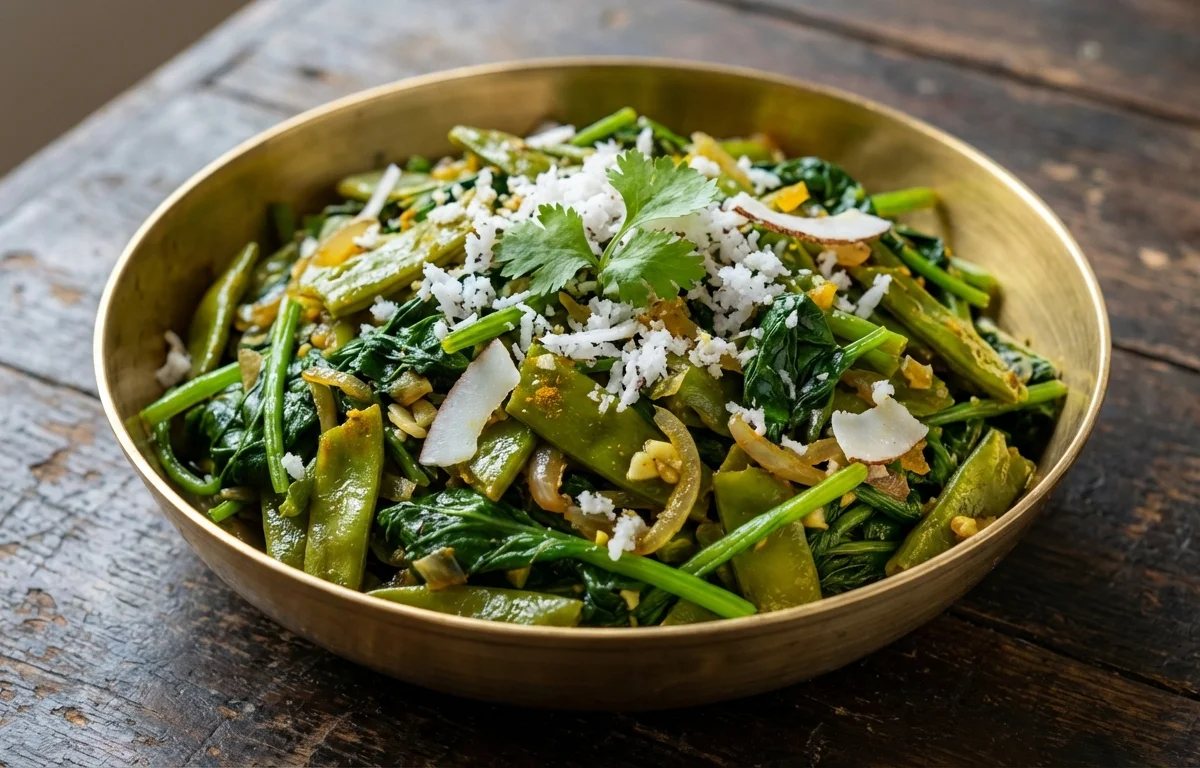
Vali Bhaji
A traditional Maharashtrian stir-fry featuring tender Malabar spinach and field beans. This wholesome dish has a unique sweet, sour, and savory flavor from coconut, jaggery, and tamarind.
For 4 servings
Prep Vegetables: Thoroughly wash the Malabar spinach and roughly chop the leaves and tender stems. Finely chop the onion, mince the garlic, and slit the green chilies. If using fresh val papdi, shell the beans.
Tempering (Tadka): Heat oil in a kadai or heavy-bottomed pan over medium heat. Add mustard seeds and allow them to splutter completely, about 30-45 seconds. Add cumin seeds and asafoetida, and sauté for another 10-15 seconds until fragrant.
Sauté Aromatics: Add the minced garlic, slit green chilies, and chopped onion to the pan. Sauté for 3-4 minutes, stirring occasionally, until the onions become soft and translucent.
Cook the Beans: Add the shelled val papdi and 1/4 cup of water. Stir well, cover the pan, and cook on medium-low heat for 5-7 minutes, or until the beans are partially cooked and tender.
Add Spinach and Spices: Add the chopped Malabar spinach, turmeric powder, goda masala, and salt. Mix everything together. The spinach will begin to wilt and reduce in volume significantly.
Cook the Bhaji: Cover the pan again and let the bhaji cook on low heat for 6-8 minutes. Stir once or twice in between to prevent sticking. Cook until both the spinach and beans are fully cooked and tender.
Add Final Flavors: Uncover the pan and add the grated jaggery, tamarind pulp, and freshly grated coconut. Stir gently to combine all the ingredients. Cook for another 2 minutes, allowing the jaggery to melt and the flavors to meld together.
Serve: Turn off the heat. Let the Vali Bhaji rest for a few minutes before serving. It tastes best served hot with bhakri (sorghum flatbread), chapati, or as a side dish with dal and steamed rice.
What to keep in mind.
5 tips from the recipe — small details that make a real difference to the final dish.
- 1The tender stems of Malabar spinach are edible and nutritious. Chop them finely and add them with the beans to ensure they cook through.
- 2Do not overcook the Malabar spinach after adding it, as it can become slimy. Cook just until wilted and tender.
- 3For the most authentic flavor, use freshly grated coconut. Desiccated coconut can be used in a pinch but should be soaked in warm water for 10 minutes first.
- 4Adjust the jaggery and tamarind quantities to suit your preference for sweet and sour notes.
- 5If using frozen val papdi, you may not need to add extra water as they release moisture upon thawing.
Adapt it for your goals.
Protein Boost
Add a handful of roasted and coarsely crushed peanuts along with the coconut for extra texture and protein.
Different BeansDifferent Beans
If val papdi is unavailable, you can substitute it with shelled fava beans, edamame, or even pre-soaked black-eyed peas (chawli).
Leafy Green SubstituteLeafy Green Substitute
Regular spinach (palak) can be used if Malabar spinach is not available. Note that regular spinach cooks much faster and lacks the slightly slimy texture of vali.
No Onion/Garlic VersionNo Onion/Garlic Version
For a sattvic or Jain-friendly version, you can omit the onion and garlic. The flavor will be different but still delicious due to the goda masala and other spices.
Why this is on our healthy list.
Rich in Vitamins and Minerals
Malabar spinach is a powerhouse of Vitamin A, Vitamin C, iron, and calcium, which are essential for healthy vision, a strong immune system, and robust bone health.
High in Dietary Fiber
The combination of field beans and spinach provides ample dietary fiber, which aids digestion, promotes a feeling of fullness, and helps in regulating blood sugar levels.
Good Source of Plant-Based Protein
Field beans (Val Papdi) are an excellent source of plant-based protein, which is crucial for muscle repair, growth, and overall body function.
Aids Digestion
Traditional spices used in the tempering, such as cumin seeds and asafoetida, are well-known for their digestive properties, helping to reduce bloating and improve gut health.
Frequently asked questions
A single serving of Vali Bhaji (approximately 210g) contains around 160-190 calories. This is an estimate and can vary based on the type of oil and the exact amounts of coconut and jaggery used.