
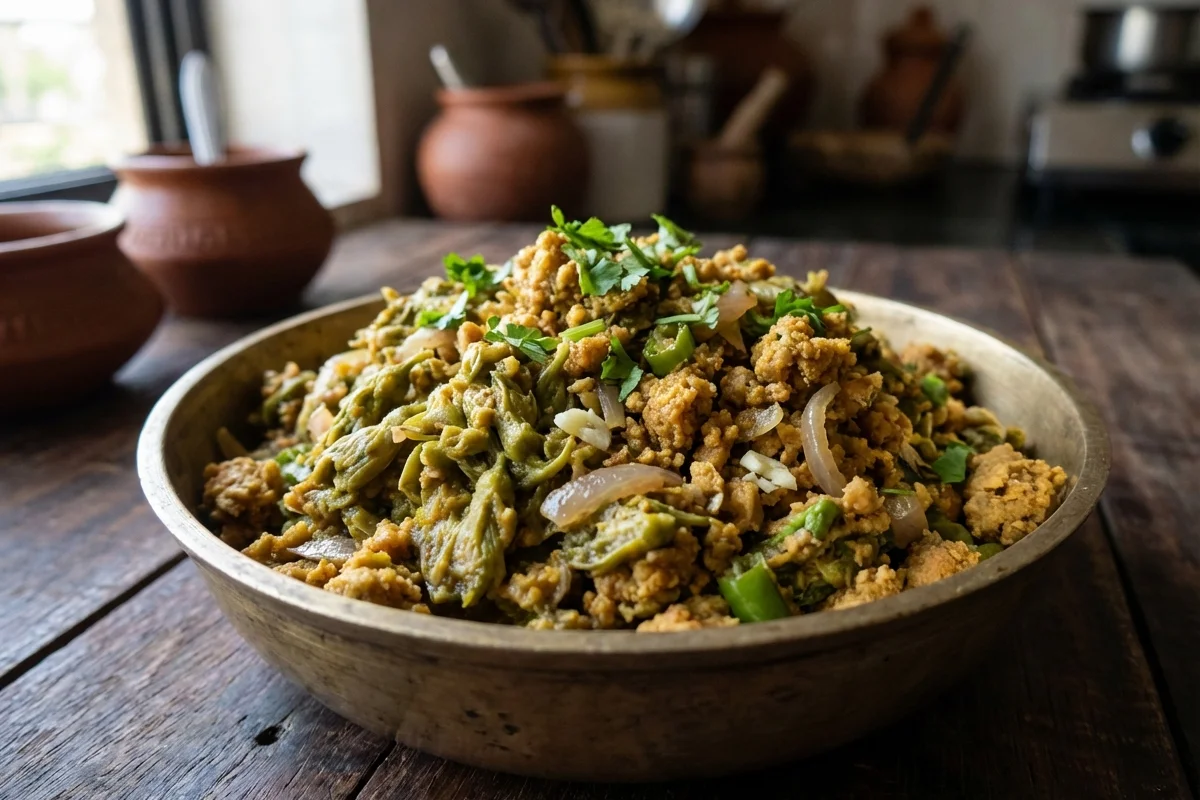
Teetaphool Bhaji
A unique Maharashtrian delicacy from the Vidarbha region, this bhaji features foraged sickle senna flowers. Their distinct bitter taste is balanced with sweet onions and garlic for a truly rustic flavor.
For 4 servings
Prepare the Flowers (15 minutes)
- Carefully pick the tiny yellow flowers from their stems, discarding any tough stalks, leaves, or unopened buds.
- Place the flowers in a large bowl of water and wash them thoroughly, changing the water 2-3 times to remove all dirt and grit.
- Drain the flowers completely in a colander.
Boil and Squeeze to Reduce Bitterness (10 minutes)
- Bring a medium pot with about 6 cups of water to a rolling boil.
- Add the cleaned teetaphool to the boiling water and cook for 5-7 minutes. The flowers will wilt and change color.
- Drain the flowers into a colander. Once cool enough to handle, take small portions and squeeze firmly between your palms to remove as much water as possible. This step is crucial for the final texture and for reducing bitterness.
Sauté the Aromatics (8 minutes)
- Heat oil in a kadai or heavy-bottomed pan over medium heat.
- Add the chopped garlic and green chilies. Sauté for 30-45 seconds until fragrant.
- Add the finely chopped onions and a pinch of salt. Cook for 6-7 minutes, stirring occasionally, until the onions are soft, translucent, and light golden brown. Their sweetness is key to balancing the dish.
Cook the Bhaji (5 minutes)
- Add the boiled and squeezed teetaphool to the pan with the onions.
- Sprinkle in the turmeric powder and the remaining salt. Mix everything together thoroughly.
- Sauté for 4-5 minutes, allowing the flowers to absorb the flavors of the aromatics.
Finish with Besan (3 minutes)
- Reduce the heat to low and sprinkle the besan (chickpea flour) evenly over the bhaji.
- Stir continuously for 2-3 minutes to roast the besan and prevent lumps from forming. The besan will absorb any residual moisture and coat the flowers, giving the dish its characteristic dry texture.
- Turn off the heat once the raw smell of the besan is gone.
Serve
- Serve the Teetaphool Bhaji hot with traditional flatbreads like Jowar Bhakri, Bajra Roti, or Phulka.
What to keep in mind.
4 tips from the recipe — small details that make a real difference to the final dish.
- 1The key to reducing bitterness is to boil the flowers and then squeeze out every drop of water. Do not skip this.
- 2Caramelizing the onions until deep golden brown is essential. Their sweetness provides the perfect balance to the bitter flowers.
- 3For an authentic Vidarbha flavor, serve with Jowar Bhakri (sorghum flatbread) or Bajra Roti (pearl millet flatbread).
- 4If the bitterness is still too strong for your palate, add a tiny piece of jaggery (about 1/2 teaspoon, grated) along with the salt.
Adapt it for your goals.
Nutty Crunch
Add 2 tablespoons of coarsely crushed roasted peanuts along with the besan for added texture and flavor.
Lentil AdditionLentil Addition
Mix in 2-3 tablespoons of cooked tur dal (pigeon peas) at the end for a more substantial, protein-rich dish.
Spice VariationSpice Variation
Add 1/4 teaspoon of Goda Masala, a classic Maharashtrian spice blend, along with the turmeric for a different flavor profile.
Why this is on our healthy list.
Supports Digestive Health
The high fiber content from the flowers and besan aids digestion, promotes regular bowel movements, and supports a healthy gut microbiome.
Rich in Antioxidants
Sickle senna flowers contain natural antioxidants that help combat oxidative stress and protect the body's cells from damage caused by free radicals.
Traditional Detoxifying Properties
In Ayurvedic medicine, Cassia tora is valued for its detoxifying properties, believed to help purify the blood and support liver function.
Low-Calorie & Nutrient-Dense
This dish is low in calories but provides essential nutrients, making it an excellent choice for weight management and a balanced diet.
Frequently asked questions
Teetaphool, or Sickle Senna (Cassia tora), are tiny yellow flowers that grow wild during the monsoon season in India, particularly in the Vidarbha region of Maharashtra. They are known for their distinct bitter taste and medicinal properties.