
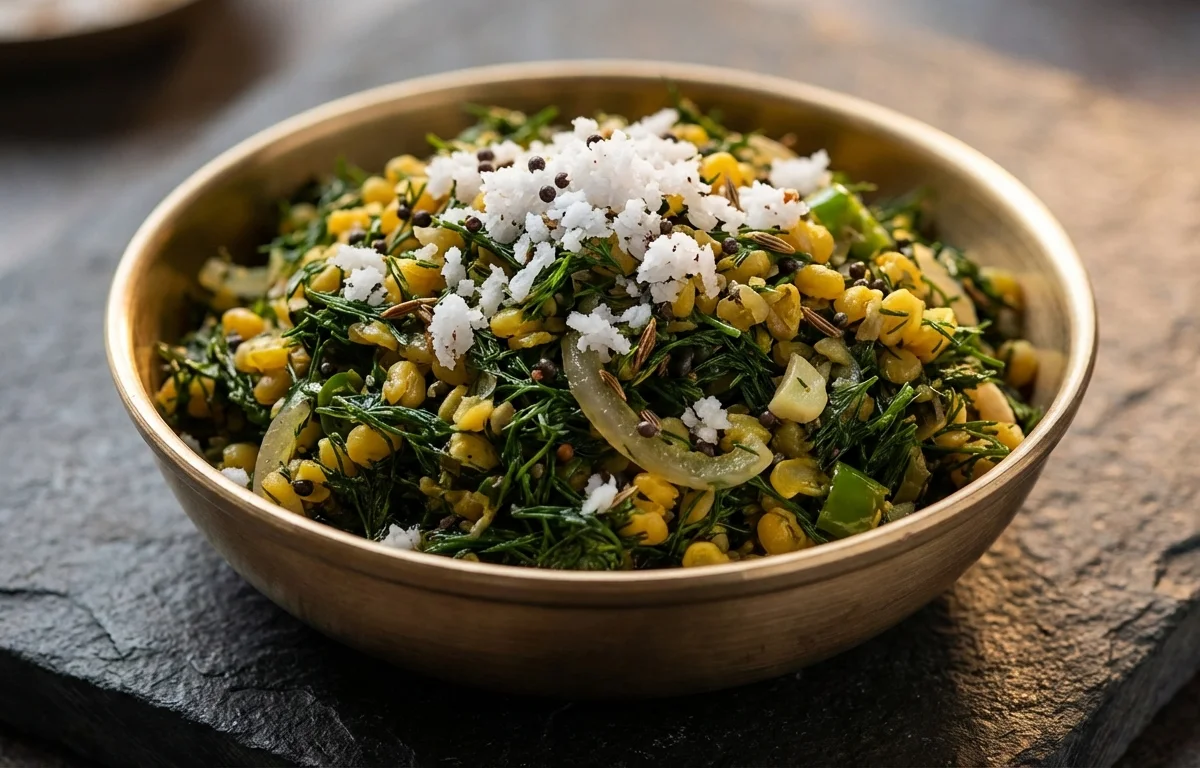
Shepu chi Bhaji
A classic Maharashtrian comfort food, this simple stir-fry features fresh dill leaves and tender moong dal. It's a healthy, quick, and flavorful dish that pairs perfectly with roti or bhakri.
For 4 servings
Preparation (15 mins)
- Rinse the moong dal thoroughly under running water. Soak it in fresh water for at least 30 minutes, then drain completely.
- Clean the dill leaves by removing thick stems and any wilted parts. Wash them well in a large bowl of water to remove grit, then chop finely.
- Finely chop the onion, garlic, and green chilies.
Tempering and Sautéing Aromatics (5 mins)
- Heat oil in a kadai or pan over medium heat. Add the mustard seeds and allow them to splutter.
- Once the mustard seeds pop, add the cumin seeds and asafoetida. Sauté for 30 seconds until fragrant.
- Add the chopped garlic and green chilies. Sauté for about a minute until the raw aroma of garlic subsides.
- Add the finely chopped onion and cook for 3-4 minutes, stirring occasionally, until it becomes soft and translucent.
Cooking the Dal (8 mins)
- Add the drained moong dal to the pan along with the turmeric powder. Mix well and sauté for one minute.
- Pour in 1/4 cup of water. Bring to a gentle simmer, then cover the pan, reduce the heat to low, and cook for 5-7 minutes until the dal is partially cooked but still holds its shape.
Cooking the Dill Leaves (7 mins)
- Add the chopped dill leaves and salt to the pan. Mix everything thoroughly. The leaves will begin to wilt quickly.
- Cover the pan again and cook on low heat for another 5-7 minutes. The dill will release its own moisture, which will help cook both the leaves and the dal completely.
- Check occasionally; if the mixture appears too dry, you can sprinkle a tablespoon of water.
Finishing and Serving (2 mins)
- Uncover the pan. Check if the dal is soft and cooked through. If there is any excess liquid, increase the heat to medium and cook for 1-2 minutes, stirring, until the moisture evaporates.
- Turn off the heat. If using, stir in the fresh grated coconut.
- Serve the Shepu chi Bhaji hot with chapati, jowar bhakri, or as a side dish with dal and rice.
What to keep in mind.
5 tips from the recipe — small details that make a real difference to the final dish.
- 1Soaking the moong dal is crucial for it to cook quickly and evenly with the dill leaves.
- 2To clean dill leaves effectively, submerge them in a large bowl of water and swish them around. Let the dirt settle, then lift the leaves out. Repeat if necessary.
- 3Avoid overcooking the dill leaves, as they can become excessively bitter. Cook just until tender.
- 4To balance the natural bitterness of dill, you can add a pinch of jaggery or sugar along with the salt.
- 5For a richer, nuttier flavor, add 1-2 tablespoons of coarsely ground roasted peanuts at the end of cooking.
Adapt it for your goals.
With Chana Dal
Substitute moong dal with chana dal for a firmer texture. Make sure to soak the chana dal for at least 2-3 hours before cooking.
With PeanutsWith Peanuts
Add 2 tablespoons of roasted and coarsely crushed peanut powder in the final step for a classic Maharashtrian flavor and texture.
No Onion/Garlic VersionNo Onion/Garlic Version
For a sattvic or Jain-friendly version, you can skip the onion and garlic. The flavor will be different but still delicious due to the tempering spices.
With PotatoesWith Potatoes
Add one small potato, finely diced, along with the onions to make the dish more substantial.
Why this is on our healthy list.
Aids Digestion
The high dietary fiber content from both dill leaves and moong dal promotes healthy digestion, prevents constipation, and supports a healthy gut microbiome.
Rich in Plant-Based Protein
Moong dal is an excellent source of vegetarian protein, which is crucial for building and repairing tissues, muscle maintenance, and overall body function.
Boosts Immunity
Dill leaves are packed with Vitamin C and Vitamin A, powerful antioxidants that help strengthen the immune system and protect the body against infections.
Supports Bone Health
Dill is a good source of calcium and manganese, essential minerals that contribute to maintaining strong and healthy bones and preventing osteoporosis.
Frequently asked questions
Yes, it is a very healthy dish. Dill leaves are rich in vitamins A and C, iron, and manganese. Moong dal provides excellent plant-based protein and dietary fiber. It's a low-calorie, nutrient-dense meal.