
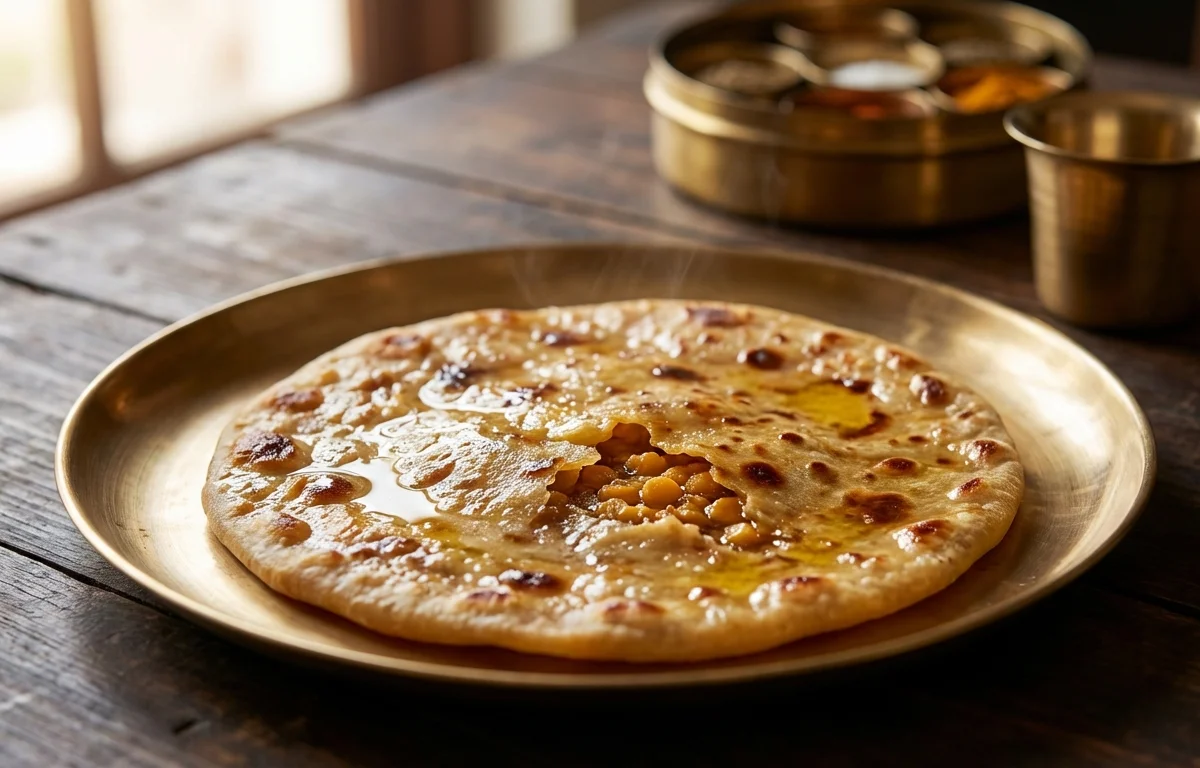
Puran Poli
A classic Maharashtrian sweet flatbread where a soft outer layer encases a delicious, aromatic filling of chana dal and jaggery. Perfect for festivals like Holi and Ganesh Chaturthi, this dish is a true taste of tradition.
For 6 servings
6 steps. 55 minutes total.
- 1
Step 1
- a.Cook the Chana Dal
- b.Rinse the chana dal thoroughly under running water. Soak it in ample water for 3-4 hours.
- c.Drain the soaking water. Transfer the dal to a pressure cooker and add 3 cups of fresh water.
- d.Pressure cook on medium heat for 4-5 whistles, or until the dal is very soft and easily mashed with a finger.
- e.Once the pressure settles, open the cooker. Drain the dal completely using a fine-mesh sieve. It's crucial that the dal is as dry as possible.
- 2
Step 2
- a.Prepare the Puran (Filling)
- b.In a heavy-bottomed pan, combine the cooked, drained dal and the grated jaggery. Cook on low-medium heat.
- c.Stir continuously as the jaggery melts. The mixture will become liquidy at first. Continue cooking for 15-20 minutes.
- d.The mixture is ready when it thickens considerably, pulls away from the sides of the pan, and a spoon inserted in the center stands upright. This is the 'spoon test'.
- e.Turn off the heat. Stir in the cardamom powder, nutmeg powder, dry ginger powder, and 1 tsp of ghee. Mix well.
- f.Allow the puran mixture to cool down completely to room temperature.
- g.Once cooled, grind the mixture into a very fine, smooth paste using a food processor or a traditional 'puran yantra'. This step is vital for a non-grainy texture.
- 3
Step 3
- a.Knead the Dough
- b.In a large bowl, whisk together the atta, maida, turmeric powder, and salt.
- c.Add 2 tbsp of ghee and rub it into the flour mixture with your fingertips until it resembles breadcrumbs.
- d.Gradually add warm water and knead for 8-10 minutes to form a very soft, smooth, and pliable dough. It should be softer than regular chapati dough.
- e.Cover the dough with a damp cloth and let it rest for at least 30-45 minutes.
- 4
Step 4
- a.Assemble and Roll the Puran Poli
- b.After resting, knead the dough again for a minute. Divide the dough and the puran filling into 12 equal-sized balls each.
- c.Take a ball of dough, dust it with rice flour, and use your fingers to flatten it into a 3-inch cup or disc.
- d.Place a ball of puran filling in the center.
- e.Gently pull the edges of the dough up and around the filling, pinching them together at the top to seal it completely. Remove any excess dough from the pinched seal.
- f.Flatten the stuffed ball gently with your palm. Dust generously with rice flour on both sides.
- g.Using very light and even pressure, roll the ball into a thin, 6-7 inch circle. Rotate the poli frequently to ensure even rolling and prevent sticking.
- 5
Step 5
- a.Cook the Puran Poli
- b.Heat a tawa (griddle) on medium heat. The tawa should be hot but not smoking.
- c.Carefully lift the rolled poli and place it on the hot tawa.
- d.Cook for about 45-60 seconds until small bubbles appear on the surface.
- e.Flip the poli. Drizzle about 1 tsp of ghee on the top surface. Cook the second side for another 45-60 seconds until golden-brown spots appear.
- f.Flip again. The poli should start to puff up. Gently press the edges with a spatula to encourage it to puff up fully like a balloon.
- g.Drizzle ghee on the other side, cook for a final 20-30 seconds, and then remove from the tawa.
- h.Repeat for all remaining polis, stacking them with parchment paper in between or in a cloth-lined container to keep them soft.
- 6
Step 6
- a.Serve
- b.Serve Puran Poli warm, generously smeared with more ghee. It pairs wonderfully with warm milk, yogurt, or a savory lentil curry called Katachi Amti.
What to keep in mind.
6 tips from the recipe — small details that make a real difference to the final dish.
- 1The dough must be extremely soft and pliable. A stiff dough will tear easily when rolling.
- 2Ensure the puran filling is completely dry and smooth. Any moisture or lumps will cause the poli to break.
- 3Use rice flour for dusting. It prevents sticking without making the poli dry or tough.
- 4Roll with a very light hand. Applying too much pressure will force the filling out.
- 5Cook on a consistent medium heat. High heat will burn the outside before the inside cooks, while low heat will make the poli hard.
- 6If a small tear appears while rolling, patch it with a tiny piece of dough and continue rolling gently.
Adapt it for your goals.
Dal Variation
Instead of chana dal, you can make the puran with toor dal (split pigeon peas) for a slightly different flavor and texture, common in the Gujarati version (Vedmi).
Coconut PuranCoconut Puran
Add 1/2 cup of freshly grated coconut to the puran mixture while cooking for a richer, coastal flavor, popular in the Konkan region.
Flour VariationFlour Variation
For a richer and softer poli, you can make the outer covering entirely with maida (all-purpose flour).
Why this is on our healthy list.
Rich in Plant-Based Protein
Chana dal is an excellent source of protein, which is essential for muscle repair, growth, and overall body function.
Good Source of Iron
Jaggery is an unrefined sugar that retains more minerals than white sugar, including iron, which is vital for preventing anemia and maintaining energy levels.
Provides Sustained Energy
The combination of complex carbohydrates from whole wheat flour and protein from lentils provides a steady release of energy, keeping you full and energetic for longer.
Frequently asked questions
This usually happens for two reasons: the dough is too stiff, or the filling is too moist or lumpy. Ensure your dough is very soft and pliable, and cook the puran filling until it's a thick, dry paste. Grinding the filling to a very smooth consistency also helps.