
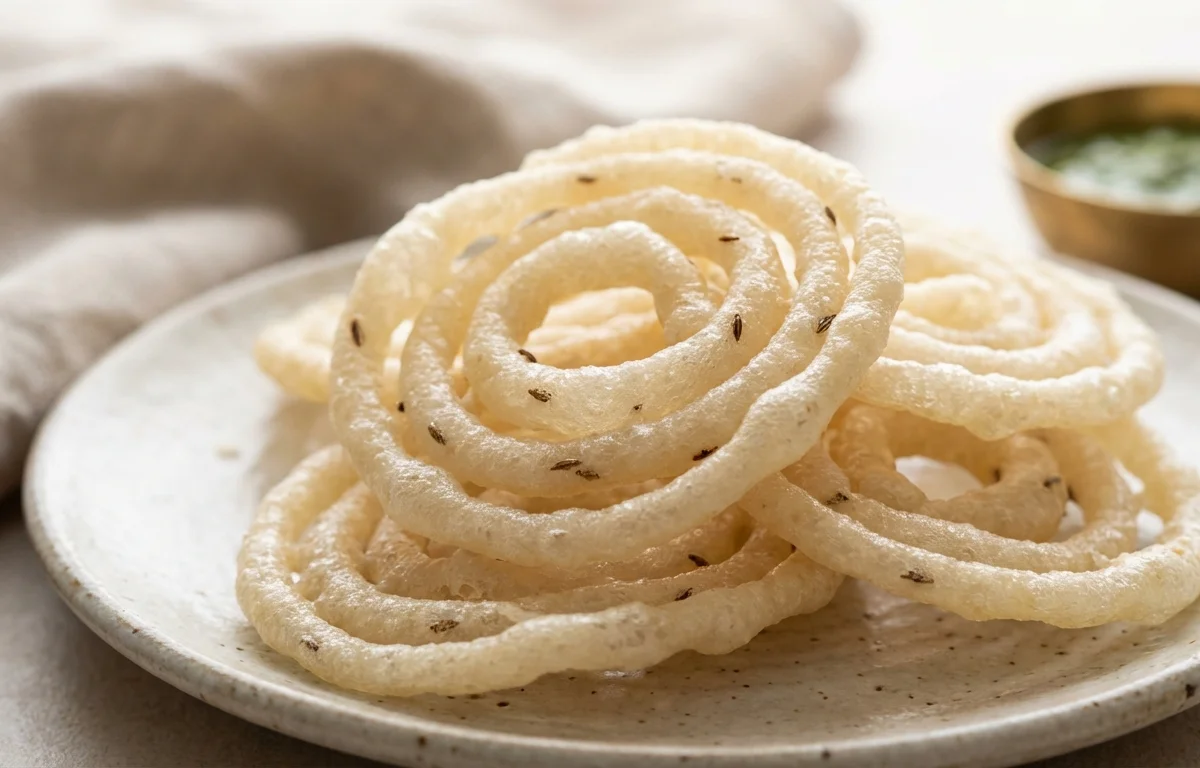
Gavhachi Kurdai
A traditional Maharashtrian sun-dried savory noodle made from fermented whole wheat. These delicate spirals are deep-fried to a light, crispy perfection, making for a classic and beloved crunchy snack.
For 10 servings
Soak and Ferment the Wheat (3 Days)
- Rinse 1 kg of whole wheat kernels thoroughly under running water until the water runs clear.
- Place the wheat in a large container and add enough water to cover it by at least 3-4 inches.
- Cover the container and let it soak for 3 full days in a cool, dark place.
- IMPORTANT: You must drain and replace the water completely every 24 hours. This prevents excessive sourness and spoilage.
Extract the Wheat Starch (Chik)
- After 3 days, drain all the water from the soaked wheat.
- In a wet grinder or a powerful blender, grind the wheat into a very fine paste. Add about 1 liter of water in batches to facilitate grinding.
- Place a large, fine-mesh sieve or a muslin cloth over a large bowl. Pour the ground wheat paste into the sieve/cloth.
- Press and squeeze the pulp firmly to extract all the thick, white liquid (this is the 'chik'). Add a little more water to the pulp and squeeze again to extract any remaining starch. Discard the fibrous pulp.
- Let the bowl of extracted chik sit undisturbed for 8-10 hours or overnight. The starch will settle at the bottom, leaving a layer of yellowish, translucent water on top.
- Carefully pour off and discard the top layer of water without disturbing the thick starch sediment at the bottom.
Cook the Kurdai Batter
- Measure the collected thick chik. The standard ratio is 1 part chik to 1.5 parts water.
- In a large, heavy-bottomed pot, bring the required amount of water (approx. 2.5 liters based on the yield from 1kg wheat) to a rolling boil.
- Add the salt and optional papad khar to the boiling water and stir.
- In a separate bowl, whisk the chik to ensure it's smooth. Slowly pour the chik into the boiling water in a thin, steady stream, while stirring the water continuously and vigorously with a whisk to prevent lumps.
- Once all the chik is added, switch to a sturdy spatula. Reduce the heat to low-medium and cook for 15-20 minutes, stirring constantly.
- The batter is cooked when it becomes thick, glossy, and translucent. It will pull away from the sides of the pot.
Shape and Sun-Dry the Kurdai (2-4 Days)
- Grease a sev or chakli press with the fine noodle disc attachment.
- Working quickly while the batter is still very hot, carefully spoon the batter into the press.
- On large plastic sheets spread out in direct, strong sunlight, press the batter out into concentric circles or spiral shapes (kurdai).
- Let the kurdai dry in the sun for 2 to 4 days, depending on the intensity of the heat.
- After the first day, when the top is dry, gently flip each kurdai to allow the other side to dry evenly.
- They are fully dried when they become brittle, hard, and easily lift off the plastic sheet.
Store and Fry for Serving
- Once completely dry and moisture-free, store the kurdai in a large, airtight container at room temperature. They can be stored for over a year.
- To serve, heat oil in a kadai or deep pan over medium-high heat.
- Test the oil temperature by dropping a small piece; it should sizzle and rise to the surface immediately.
- Gently slide one kurdai into the hot oil. It will expand to 2-3 times its size and turn white in about 5-10 seconds.
- Using a slotted spoon, immediately remove it from the oil and place it on a paper towel to drain excess oil. Serve hot and crispy.
What to keep in mind.
6 tips from the recipe — small details that make a real difference to the final dish.
- 1Changing the soaking water daily is the most critical step to ensure a pleasant flavor and prevent a strong, unpleasant odor.
- 2Use a heavy-bottomed pot for cooking the batter to prevent it from scorching at the bottom.
- 3Stir the batter continuously and vigorously while cooking to get a smooth, lump-free consistency.
- 4The batter must be pressed while it is still hot. If it cools, it becomes too stiff to press through the sev maker.
- 5Ensure the kurdai are completely moisture-free and brittle before storing, otherwise they can develop mold.
- 6Fry the kurdai in properly heated oil. If the oil is not hot enough, they will absorb excess oil and become greasy.
Adapt it for your goals.
Spiced Kurdai
Add 1 teaspoon of cumin seeds (jeera) or carom seeds (ajwain) to the boiling water before adding the chik for a savory, spiced flavor.
Rava KurdaiRava Kurdai
A quicker version can be made using fine semolina (rava) instead of whole wheat, which eliminates the long soaking and grinding process.
Colored KurdaiColored Kurdai
Add a pinch of turmeric for a yellow hue or a small amount of beetroot juice for a pink color to the batter before cooking.
Why this is on our healthy list.
Source of Complex Carbohydrates
Made from whole wheat, kurdai provides complex carbohydrates that offer sustained energy release compared to simple carbs.
Promotes Gut Health
The 3-day soaking and fermentation process can increase the bioavailability of nutrients and introduce beneficial bacteria, which can be good for digestive health.
Rich in Fiber
As a whole grain product, it retains dietary fiber which aids in digestion, promotes satiety, and helps maintain stable blood sugar levels.
Frequently asked questions
Lumps usually form if the chik is not poured into the boiling water slowly and steadily, or if the mixture is not stirred continuously and vigorously during the initial mixing and cooking phase.