
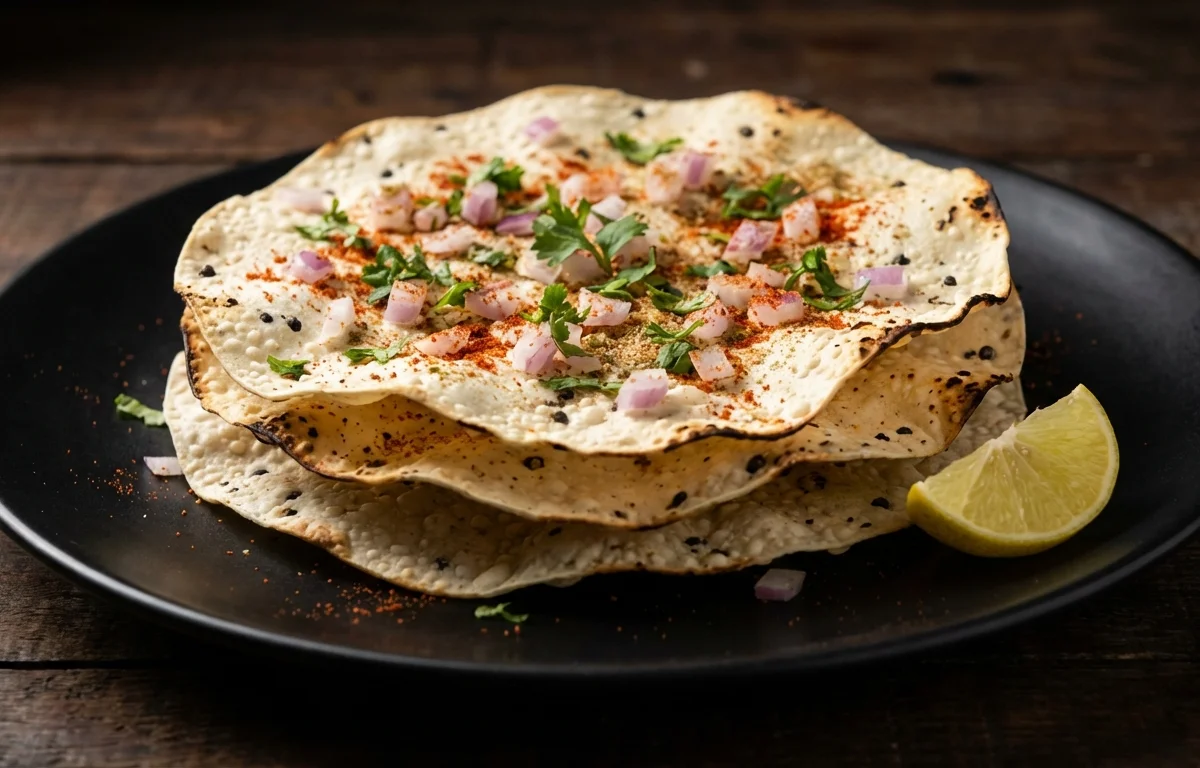
Urad Dal Papad
Crispy, sun-dried lentil wafers made from urad dal flour and spiced with black pepper and hing. A classic Indian accompaniment that's perfect for roasting or frying to enjoy with any meal. This recipe guides you through the traditional process of making these iconic crackers from scratch.
For 8 servings
8 steps.
- 1
Step 1
- a.Prepare the Flour Mixture
- b.In a large bowl, sift the urad dal flour. Add the coarsely crushed black peppercorns, hing, papad khar, and salt.
- c.Whisk everything together until the spices are evenly distributed throughout the flour.
- 2
Step 2
- a.Form the Stiff Dough
- b.Gradually add water, just one teaspoon at a time, to the flour mixture.
- c.Mix and gather the flour to form an extremely stiff, tight, and almost dry dough. It's crucial to use as little water as possible. The dough will look crumbly at first.
- 3
Step 3
- a.Pound the Dough
- b.Transfer the dough to a sturdy, clean surface. Grease a pestle (or the back of a heavy pan) and your hands with a little sesame oil.
- c.Begin pounding the dough firmly for 15-20 minutes. This process is essential to develop gluten and make the dough pliable.
- d.The texture will transform from crumbly to a smooth, elastic ball. This step cannot be skipped for authentic results.
- 4
Step 4
- a.Rest the Dough
- b.Rub a little more oil over the surface of the dough ball.
- c.Cover it with a damp cloth and let it rest for 30 minutes. This allows the flour to hydrate fully and makes rolling easier.
- 5
Step 5
- a.Shape into Logs and Pellets
- b.After resting, knead the dough for another 2-3 minutes. Divide it into 2-3 equal portions.
- c.Roll each portion into a long, uniform log about 1-inch in diameter.
- d.Cut the logs into small, equal-sized pellets, about the size of a small marble. Keep the pellets covered with the damp cloth to prevent them from drying out.
- 6
Step 6
- a.Roll the Papads
- b.Lightly grease your rolling surface and rolling pin with sesame oil.
- c.Take one pellet, flatten it with your palm, and roll it into a very thin, translucent circle, about 4-5 inches in diameter.
- d.The key is to roll them as thinly as possible without tearing. Place the rolled papads on a clean cotton cloth or plastic sheet, ensuring they don't overlap.
- 7
Step 7
- a.Dry the Papads
- b.Place the sheets with the papads in direct, strong sunlight for 1-2 days. Flip them every 3-4 hours for even drying.
- c.Alternatively, dry them indoors under a fan for 2-3 days, or in an oven set to its lowest temperature (around 50-60°C or 120-140°F) with the door slightly ajar for 4-6 hours, flipping halfway through.
- d.They are ready when they are completely moisture-free, brittle, and snap easily.
- 8
Step 8
- a.Store and Cook
- b.Once completely dry, stack the papads and store them in an airtight container at room temperature. They will last for several months.
- c.To cook, you can either deep-fry in hot oil for 3-5 seconds until they puff up, or roast them directly over a gas flame using tongs, flipping constantly until crisp and lightly charred.
What to keep in mind.
6 tips from the recipe — small details that make a real difference to the final dish.
- 1The secret to crispy papad is an extremely stiff dough. Use minimal water; the dough should feel almost too dry to come together initially.
- 2Pounding the dough is non-negotiable. It breaks down the proteins and creates the elasticity needed for thin rolling. Kneading by hand is very difficult for this dough.
- 3For perfectly uniform papads, you can use a tortilla press or a pasta machine (set to the thinnest setting) to flatten the dough pellets before rolling.
- 4Roll the papads from the center outwards, rotating the disc frequently to maintain a circular shape and even thickness.
- 5Ensure the papads are 100% bone-dry before storing. Any residual moisture will cause them to spoil or become moldy.
- 6If you don't have Papad Khar, you can substitute it with 1/2 tsp of baking soda mixed with a pinch of salt, but the texture will be slightly different.
Adapt it for your goals.
Spicy Version
Add 1 teaspoon of red chili flakes or crushed dried red chilies to the flour for a spicy kick.
Garlic PapadGarlic Papad
Incorporate 1 teaspoon of garlic powder into the dry ingredients for a pungent, garlicky flavor.
Cumin & AjwainCumin & Ajwain
Add 1 teaspoon of roasted cumin seeds (jeera) and 1/2 teaspoon of carom seeds (ajwain) for a different flavor profile.
Moong Dal BlendMoong Dal Blend
Replace 1/4 cup of urad dal flour with moong dal flour for a slightly lighter texture and flavor.
Why this is on our healthy list.
Rich in Plant-Based Protein
Urad dal is an excellent source of protein, which is essential for muscle building, tissue repair, and overall body function.
Good Source of Dietary Fiber
The lentil flour provides dietary fiber, which aids in digestion, promotes gut health, and helps in maintaining stable blood sugar levels.
Aids Digestion
Spices like hing (asafoetida) and black pepper are traditionally known for their digestive properties, helping to reduce bloating and indigestion.
Frequently asked questions
An uncooked Urad Dal Papad has approximately 25-30 calories. When roasted over a flame, the calorie count remains the same. If deep-fried, it can absorb oil, increasing the count to 40-50 calories per papad.