
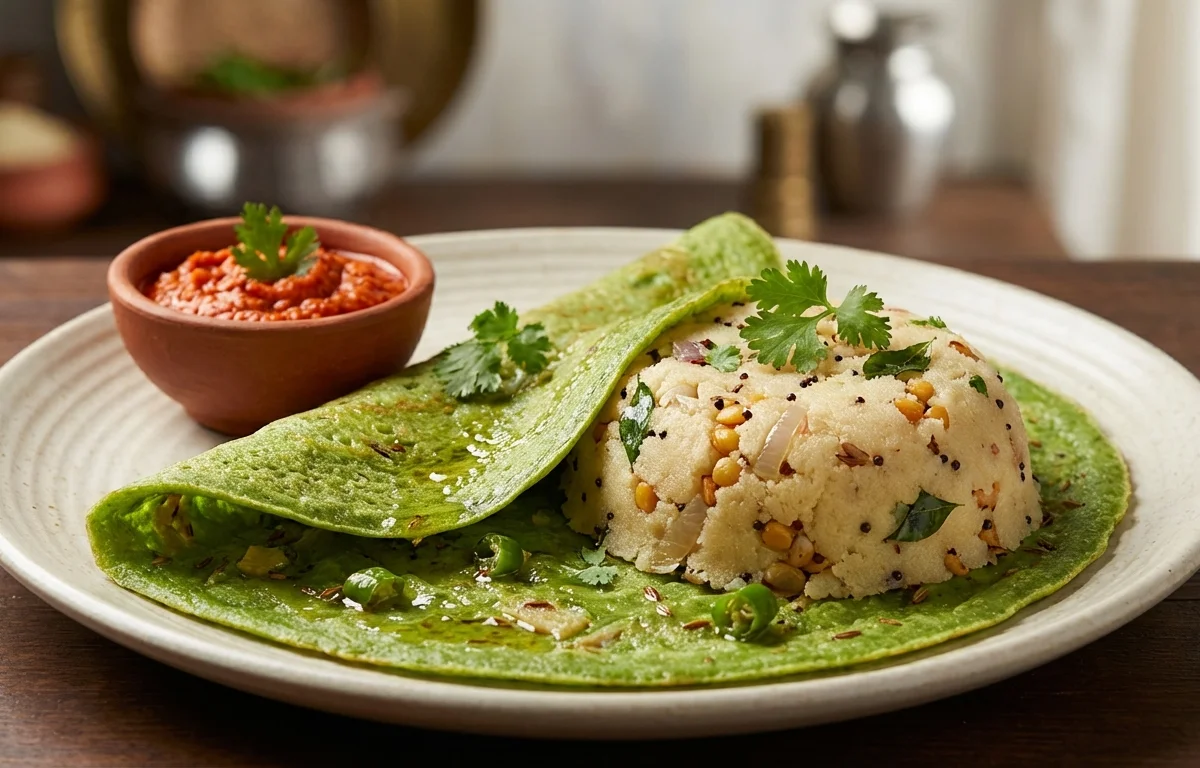
Upma Pesarattu
A classic Andhra breakfast featuring a crispy, golden crepe made from green gram lentils, generously stuffed with soft, savory semolina upma. It's a wholesome, protein-packed meal that's both delicious and satisfying.
For 4 servings
4 steps. 35 minutes total.
- 1
Step 1
- a.Prepare the Pesarattu Batter (Soaking time: 6 hours)
- b.Wash the whole green moong dal and rice thoroughly under running water.
- c.Soak them together in plenty of water for at least 6 hours or overnight. Note: Soaking time is not included in the prep time.
- d.After soaking, drain the water completely.
- e.In a high-speed blender, combine the soaked dal and rice, chopped ginger, green chillies, and cumin seeds.
- f.Add about 3/4 cup of water and blend to a smooth, thick batter. Add more water one tablespoon at a time only if needed. The consistency should be pourable but not watery, similar to dosa batter.
- g.Transfer the batter to a large bowl, stir in 1.5 tsp of salt, and mix well. Do not ferment this batter; it should be used fresh.
- 2
Step 2
- a.Make the Upma Filling (15-20 minutes)
- b.Heat 2 tbsp of oil in a pan or kadai over medium heat. Add the mustard seeds and allow them to splutter.
- c.Add the urad dal and chana dal. Sauté for about a minute until they turn a light golden brown.
- d.Add the curry leaves, hing, and 1 finely chopped onion. Sauté for 3-4 minutes until the onions become soft and translucent.
- e.Reduce the heat to low, add the rava (semolina), and roast for 4-5 minutes, stirring continuously, until it becomes aromatic and lightly toasted. Do not let it brown.
- f.While stirring constantly with one hand, slowly pour in 2 cups of hot water with the other hand to prevent lumps from forming.
- g.Add 0.75 tsp of salt, mix everything well, cover the pan, and cook on low heat for 5-6 minutes until all the water is absorbed and the rava is fluffy and cooked through.
- h.Turn off the heat and let the upma rest, covered, for 5 minutes before using. The upma should be thick and hold its shape.
- 3
Step 3
- a.Cook the Upma Pesarattu (3-4 minutes per piece)
- b.Heat a non-stick tawa or a seasoned cast-iron skillet over medium-high heat. To check if it's ready, sprinkle a few drops of water; they should sizzle and evaporate immediately.
- c.Pour a ladleful of the pesarattu batter (about 1/2 cup) onto the center of the hot tawa.
- d.Using the back of the ladle, quickly spread the batter in a circular motion, moving from the center outwards to form a thin, even crepe.
- e.Sprinkle a generous amount of the remaining finely chopped onion over the surface of the pesarattu.
- f.Drizzle about 1 tsp of oil around the edges and a little on top.
- g.Cook for 2-3 minutes, or until the base is golden brown and crispy, and the edges begin to lift away from the tawa. There is no need to flip it.
- 4
Step 4
- a.Assemble and Serve
- b.Once the pesarattu is cooked, spoon 2-3 tablespoons of the prepared upma onto one half of the crepe.
- c.Carefully fold the other half over the upma filling.
- d.Gently press down with a spatula, cook for another 30 seconds, and then slide it onto a serving plate.
- e.Repeat the process with the remaining batter and upma filling.
- f.Serve the Upma Pesarattu immediately while it's hot and crispy, traditionally with Allam Pachadi (ginger chutney) or coconut chutney.
What to keep in mind.
6 tips from the recipe — small details that make a real difference to the final dish.
- 1For the crispiest pesarattu, ensure the batter is not too thin and the tawa is very hot before pouring the batter.
- 2Adding rice to the moong dal is the traditional secret to a crispy texture that holds well.
- 3Do not ferment the pesarattu batter. It is meant to be used fresh for its characteristic taste and texture.
- 4The upma filling should be thick and not runny. A moist upma will make the pesarattu soggy from the inside.
- 5Roasting the rava well on low heat is crucial for a fluffy, non-sticky upma.
- 6For an authentic 'MLA Pesarattu' experience, use ghee instead of oil for cooking the crepes to get a rich aroma and flavor.
Adapt it for your goals.
Stuffing
Instead of upma, you can stuff the pesarattu with paneer bhurji, mixed vegetable stir-fry, or spiced mashed potatoes for a different flavor profile.
ToppingTopping
Add grated carrots, finely chopped coriander leaves, or grated fresh coconut on top of the pesarattu along with the onions for extra flavor and nutrition.
HealthierHealthier
To make it healthier, use minimal oil on a good quality non-stick pan. You can also boost its nutritional value by adding finely chopped spinach or fenugreek leaves (methi) to the batter.
SpicierSpicier
For a spicier version, increase the number of green chillies in the batter or add a pinch of red chilli powder to the upma filling.
Why this is on our healthy list.
Rich in Plant-Based Protein
Whole green moong dal is an excellent source of plant-based protein, which is essential for muscle repair, building tissues, and overall body function.
High in Dietary Fiber
The combination of moong dal and semolina provides a significant amount of dietary fiber, which aids digestion, promotes gut health, and helps in maintaining stable blood sugar levels.
Provides Sustained Energy
The complex carbohydrates from rava (semolina) and rice are digested slowly, providing a steady release of energy that keeps you feeling full and energetic for longer.
Packed with Micronutrients
This dish is a good source of essential micronutrients like iron, magnesium, potassium, and B-vitamins, which are vital for energy production, nerve function, and maintaining healthy blood cells.
Frequently asked questions
One Upma Pesarattu contains approximately 350-400 calories, depending on the amount of oil and ghee used. It's a well-balanced meal with protein from moong dal, carbohydrates from rava, and essential fats.