
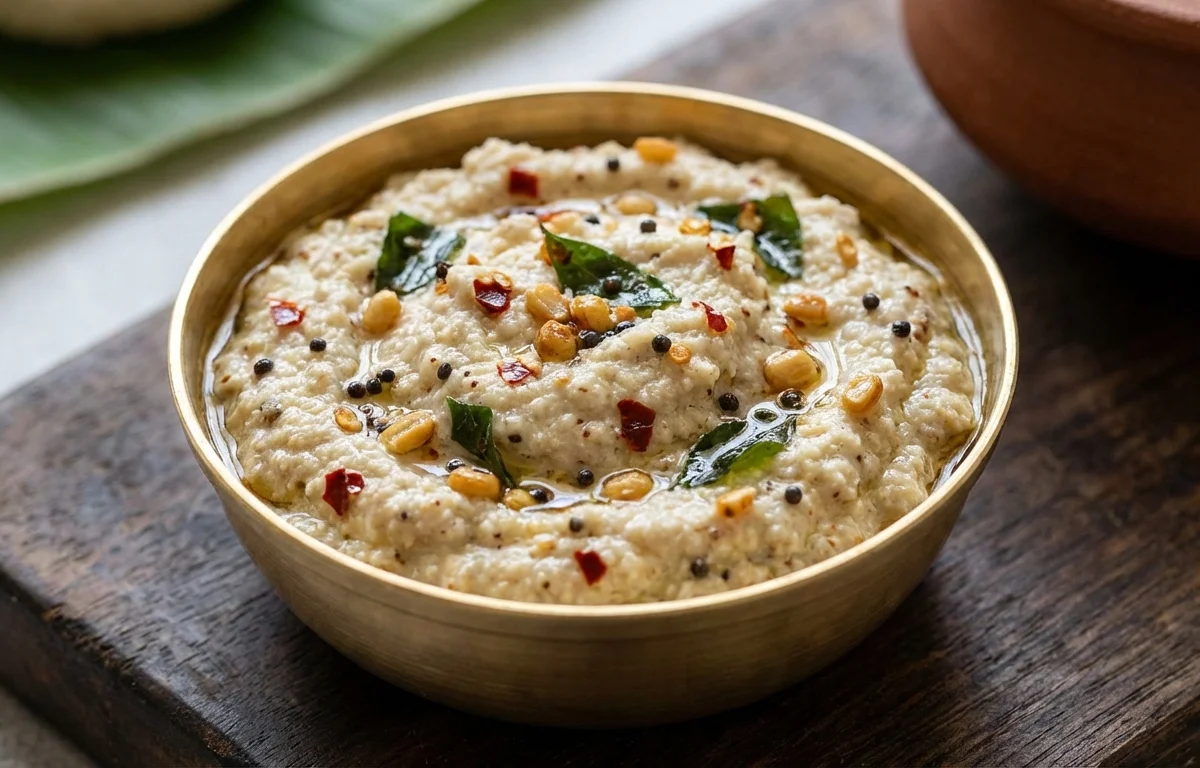
Thengai Thuvaiyal
A robust and coarse South Indian chutney made with freshly grated coconut, roasted urad dal, and dried red chilies. This thick, tangy, and spicy condiment, known as thuvaiyal, is traditionally served mixed with hot rice and a dollop of ghee or as a side for idli and dosa.
For 6 servings
Roast Lentils and Spices
- Heat 1 tablespoon of sesame oil in a small pan or kadai over low-medium heat.
- Add the urad dal and roast, stirring continuously, for about 3-4 minutes until it turns a deep golden brown and becomes fragrant. This step is crucial for the nutty flavor.
- Add the dried red chilies and hing to the pan. Sauté for another 30-45 seconds until the chilies puff up slightly. Be careful not to burn them.
- Turn off the heat and transfer the roasted ingredients to a plate to cool down completely.
Grind the Thuvaiyal
- Once cooled, add the roasted dal and chili mixture to a blender jar.
- Add the fresh grated coconut, tamarind paste, and salt.
- First, pulse a few times without any water to break down the ingredients into a coarse powder.
- Then, add water 1 tablespoon at a time, and grind to a thick, coarse paste. The final texture should not be smooth or runny. Scrape down the sides as needed.
Prepare the Tempering (Tadka)
- In the same small pan, heat the remaining 0.5 tablespoon of sesame oil over medium-high heat.
- Once the oil is hot, add the mustard seeds. Wait for them to splutter completely, which should take about 30 seconds.
- Carefully add the curry leaves, standing back as they will crackle. Sauté for 10 seconds until crisp.
Combine and Serve
- Transfer the ground thuvaiyal from the blender to a serving bowl.
- Pour the hot tempering over the thuvaiyal and mix well to combine.
- Serve immediately with hot steamed rice, sambar, rasam, or curd rice.
What to keep in mind.
5 tips from the recipe — small details that make a real difference to the final dish.
- 1For the most authentic taste, always use fresh coconut. Frozen can be used after thawing, but the flavor profile will be slightly different.
- 2Roasting the urad dal on low-medium heat is key. Rushing this step on high heat will burn the outside while leaving the inside raw, affecting the final taste.
- 3This thuvaiyal is meant to be thick. Add water very sparingly, just enough to help the blender blades move.
- 4The type of dried red chili used will impact the color and heat. Use Byadgi or Kashmiri chilies for a vibrant color and mild heat, or Guntur for more spiciness.
- 5For a perfectly balanced flavor, you can add a tiny piece of jaggery (about 1/4 teaspoon) while grinding.
Adapt it for your goals.
Garlic Thuvaiyal
Add 2-3 cloves of fresh garlic and roast them along with the urad dal for a pungent and aromatic variation.
Ginger ThuvaiyalGinger Thuvaiyal
Incorporate a 1/2-inch piece of fresh ginger while grinding the chutney for a sharp, zesty flavor.
Herby ThuvaiyalHerby Thuvaiyal
Add a small handful of fresh mint leaves (pudina) or coriander leaves (dhania) to the blender for a fresh, herby twist.
Mixed Dal ThuvaiyalMixed Dal Thuvaiyal
Use a combination of 1 tablespoon urad dal and 1 tablespoon chana dal for a more complex nutty flavor.
Why this is on our healthy list.
Rich in Healthy Fats
Coconut provides Medium-Chain Triglycerides (MCTs), a type of saturated fat that is easily digested and converted into energy by the body.
Good Source of Fiber
The combination of coconut and urad dal offers significant dietary fiber, which aids in digestion, promotes satiety, and supports overall gut health.
Provides Plant-Based Protein
Urad dal is an excellent source of plant-based protein, which is essential for building and repairing tissues and maintaining muscle mass.
Contains Essential Minerals
Coconut is a good source of manganese, which is crucial for bone health, metabolism, and antioxidant function.
Frequently asked questions
A single serving of approximately 2 tablespoons (30g) contains around 70-90 calories, primarily from the coconut and oil.