
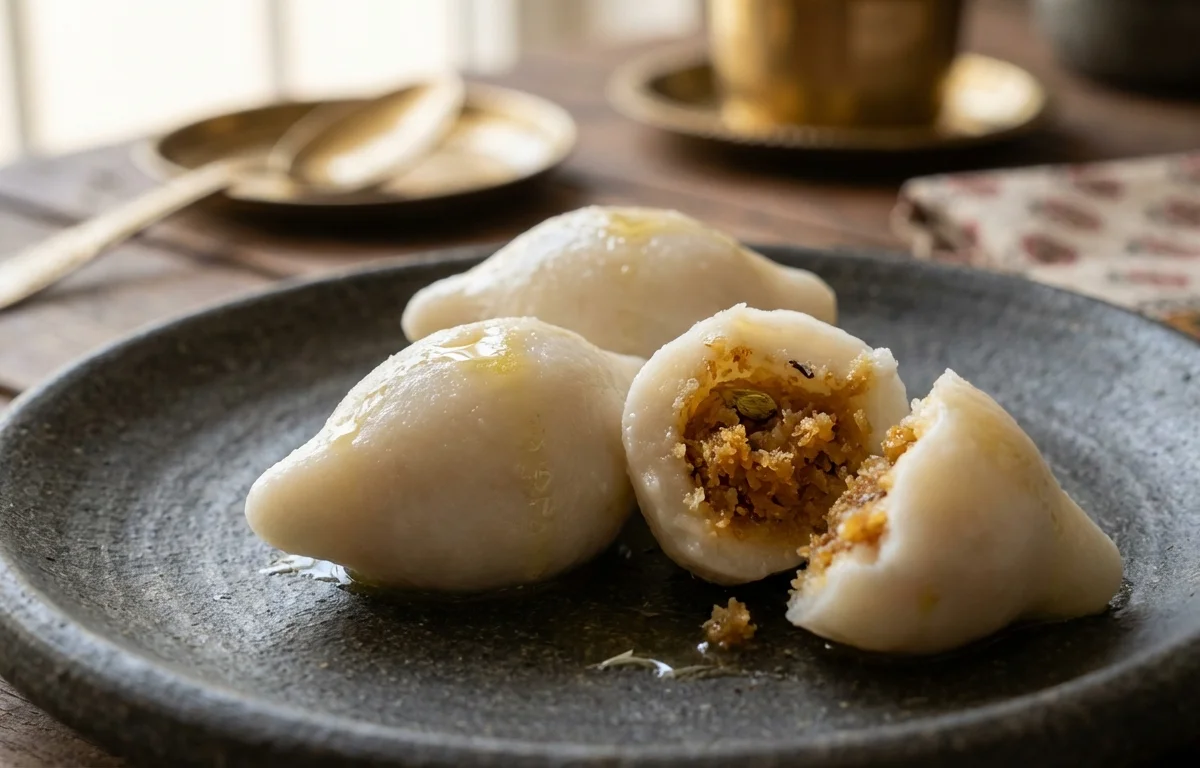
Sweet Kozhukattai
Tender, steamed rice flour dumplings filled with a luscious mixture of sweet jaggery and fresh coconut. This traditional South Indian sweet is a festive favorite, especially during Ganesh Chaturthi, and is loved for its soft texture and aromatic filling.
For 4 servings
Prepare the Sweet Filling (Poornam)
- In a heavy-bottomed pan, combine the powdered jaggery and 1/4 cup of water. Heat on a low-medium flame, stirring until the jaggery melts completely into a syrup, which takes about 3-4 minutes.
- Strain the jaggery syrup through a fine-mesh sieve into a clean pan to remove any impurities. This step is crucial for a clean filling.
- Return the pan to the stove. Add the grated coconut to the strained syrup and cook, stirring continuously.
- Cook for 5-7 minutes until the mixture thickens, loses most of its moisture, and starts to leave the sides of the pan. Be careful not to overcook, or it will become hard.
- Turn off the heat, stir in the cardamom powder, and mix well. Transfer the filling to a bowl and allow it to cool completely before use.
Prepare the Outer Dough
- In a separate pot, bring 1.5 cups of water to a rolling boil. Add the salt and sesame oil and stir.
- Reduce the heat to the lowest setting. Add the rice flour all at once and use a wooden spoon or spatula to mix quickly and vigorously until it forms a rough, lumpy mass with no dry flour visible.
- Turn off the heat, cover the pot with a tight-fitting lid, and let it rest for 5-7 minutes. The trapped steam will cook the flour further, making it soft.
- Transfer the warm dough to a large plate or kneading surface. Grease your hands with a little oil and knead the dough for 3-5 minutes while it's still warm until it becomes smooth, soft, and pliable without any cracks.
Shape the Kozhukattai
- Divide the smooth dough into 12 equal-sized balls. Keep the dough balls covered with a damp cloth to prevent them from drying out.
- Take one ball of dough and grease your fingers with oil. Flatten it into a small cup or disc (about 2-3 inches in diameter) by pressing the center and thinning the edges.
- Place about 1 to 1.5 teaspoons of the cooled sweet filling in the center of the dough cup.
- Carefully bring the edges of the dough together to enclose the filling. Pinch the seams to seal it tightly. You can shape it into a traditional crescent (modak shape) or a simple round ball.
- Repeat the process for the remaining dough and filling.
Steam the Dumplings
- Grease a steamer plate or idli plates with a little oil or ghee to prevent sticking.
- Arrange the shaped kozhukattai on the plate, ensuring they have some space between them and are not touching.
- Pour water into the base of your steamer or pressure cooker and bring it to a boil.
- Place the steamer plate inside, cover with a lid, and steam over medium heat for 10-12 minutes. If using a pressure cooker, do not use the whistle/weight.
- The kozhukattai are perfectly cooked when the outer shell appears translucent, glossy, and is not sticky to the touch.
Serve
- Turn off the heat and let the kozhukattai rest in the steamer for 5 minutes before opening the lid. This prevents them from breaking.
- Carefully remove the dumplings and serve them warm as a festive snack or dessert.
What to keep in mind.
7 tips from the recipe — small details that make a real difference to the final dish.
- 1For the softest outer covering, use fine, store-bought rice flour, often labeled as 'idiyappam flour' or 'appam flour'.
- 2Kneading the dough while it's still warm is key to achieving a smooth, crack-free texture. If it's too hot, wait a minute, but don't let it cool completely.
- 3If your dough feels dry and cracks while shaping, sprinkle a few drops of warm water and knead again.
- 4Do not overcook the coconut-jaggery filling; it should be moist, not dry. Overcooking will make it hard and chewy once cooled.
- 5Grease your hands with oil or ghee while shaping the dumplings to prevent the dough from sticking.
- 6Ensure the dumplings are sealed perfectly to prevent the sweet filling from oozing out during the steaming process.
- 7Store leftovers in an airtight container in the refrigerator for up to 2 days. Reheat by steaming for 3-4 minutes until soft again.
Adapt it for your goals.
Savory Filling
Create a savory version called 'Ulundu Kozhukattai' by filling the dumplings with a spiced mixture of steamed urad dal, green chilies, ginger, and curry leaves.
Nutty AdditionNutty Addition
Enhance the sweet filling by adding 2-3 tablespoons of chopped cashews, almonds, or roasted sesame seeds for extra crunch and flavor.
Ragi Flour ShellRagi Flour Shell
For a healthier alternative, make the outer shell using ragi (finger millet) flour instead of rice flour. The method for preparing the dough remains the same.
Lentil FillingLentil Filling
Make 'Pasi Paruppu Poornam' by using a filling of cooked and mashed moong dal (split yellow lentils) sweetened with jaggery and flavored with cardamom.
Why this is on our healthy list.
Source of Natural Energy
The combination of rice flour and jaggery provides complex carbohydrates and unrefined sugar, offering a sustained release of energy, making it a perfect festive snack.
Rich in Healthy Fats
Fresh coconut is a good source of medium-chain triglycerides (MCTs), a type of healthy fat that is easily digested and can provide quick energy.
Naturally Gluten-Free
Made entirely from rice flour, this sweet is naturally gluten-free, making it an excellent dessert option for individuals with celiac disease or gluten sensitivity.
Frequently asked questions
Sweet Kozhukattai is a traditional sweet that is healthier than many processed desserts. It uses natural sweeteners like jaggery and whole foods like coconut. However, it is high in carbohydrates and sugar, so it should be enjoyed in moderation as part of a balanced diet, especially during festive occasions.