
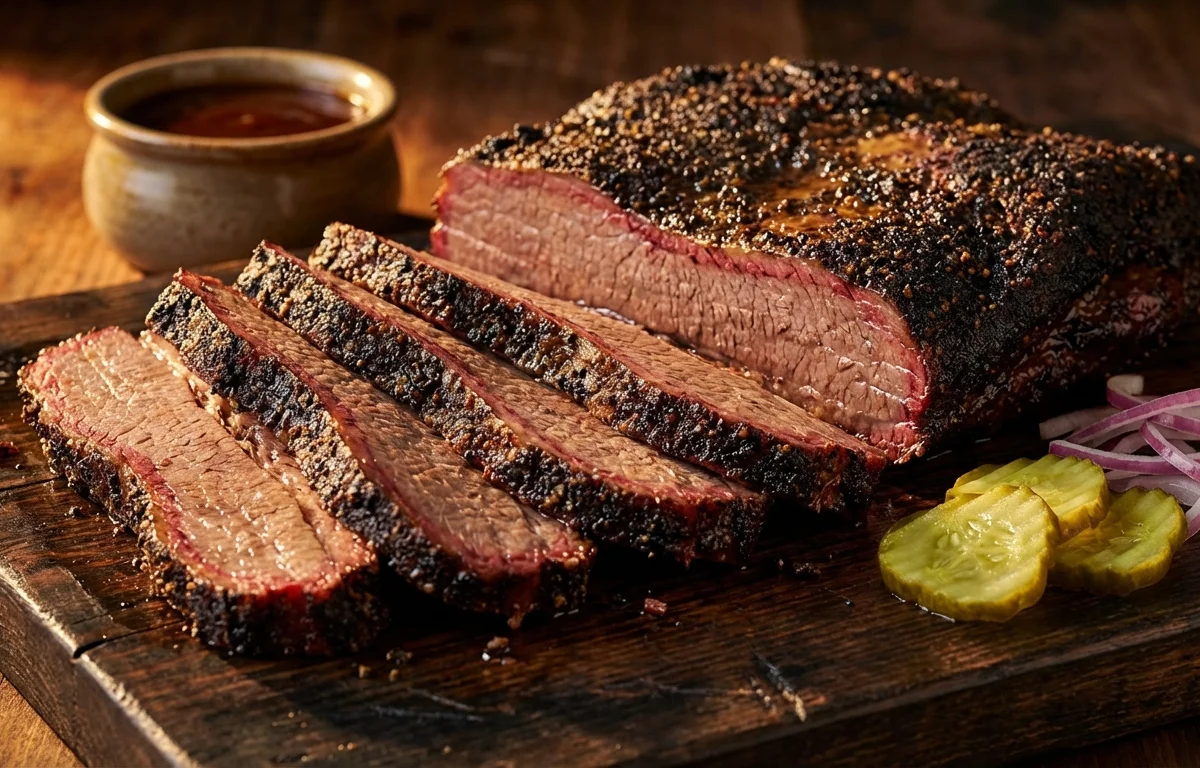
Smoked Brisket
A true labor of love, this tender, juicy Texas-style smoked brisket boasts a beautiful dark bark and a melt-in-your-mouth texture. The classic salt-and-pepper rub lets the rich beef and smoky flavor shine through, creating an unforgettable barbecue experience.
For 12 servings
9 steps. 600 minutes total.
- 1
Step 1
- a.Prepare the Dry Rub
- b.In a small bowl, thoroughly mix the kosher salt, coarse black pepper, and optional garlic and onion powders. This simple rub is classic for Texas-style brisket, allowing the beef and smoke flavors to be the stars.
- 2
Step 2
- a.Trim the Brisket (15 minutes)
- b.Place the cold brisket on a large cutting board, fat-side up. Using a sharp boning knife, trim the thick, hard fat cap down to a uniform 1/4-inch thickness. This layer will render during the long cook and keep the meat moist.
- c.Flip the brisket and remove any large, hard chunks of fat and any silver skin from the meat side.
- d.Slightly round off the edges of the brisket to prevent them from drying out and burning.
- 3
Step 3
- a.Season the Brisket (10 minutes)
- b.Pat the entire brisket dry with paper towels. This helps the binder and rub adhere.
- c.If using, slather a very thin layer of yellow mustard all over the brisket. This acts as a binder for the rub; the mustard flavor will cook off completely.
- d.Generously and evenly apply the dry rub on all sides, including the edges. Don't be shy; a thick, even coat is essential for developing a good bark.
- e.Let the seasoned brisket rest at room temperature for 30-60 minutes while you prepare the smoker.
- 4
Step 4
- a.Prepare the Smoker (15 minutes)
- b.Preheat your smoker to a consistent 250°F (121°C).
- c.Once the smoker reaches temperature, add your wood chunks.
- d.In a food-safe spray bottle, combine the apple cider vinegar and water. Shake well.
- 5
Step 5
- a.Smoke the Brisket - Phase 1 (5-6 hours)
- b.Place the brisket on the smoker grate, fat-side up. Insert a leave-in meat probe into the thickest part of the flat, avoiding the large fat seam.
- c.Close the lid and smoke until a dark, mahogany-colored bark has formed. This typically takes 5-6 hours.
- d.After the first 3 hours, begin spritzing the brisket with the vinegar-water mixture every 45-60 minutes to keep the surface moist and help smoke adhere.
- e.Continue smoking until the internal temperature reaches about 165°F (74°C). The brisket's temperature will likely 'stall' around this point.
- 6
Step 6
- a.Wrap the Brisket - The Texas Crutch (5 minutes)
- b.Lay out two large, overlapping sheets of unwaxed butcher paper on a clean surface.
- c.Carefully remove the brisket from the smoker and place it in the center of the paper.
- d.Spritz the brisket one last time, then wrap it as tightly as possible, folding the edges to create a sealed but breathable package. This helps power through the stall while preserving the bark.
- 7
Step 7
- a.Finish Smoking - Phase 2 (4-5 hours)
- b.Return the wrapped brisket to the smoker, re-inserting the meat probe through the paper into the same spot.
- c.Continue to cook until the internal temperature reaches approximately 203°F (95°C).
- d.The most important indicator of doneness is 'probe tenderness'. The probe should slide into the meat with very little resistance, similar to probing a jar of peanut butter. Check in multiple spots.
- 8
Step 8
- a.Rest the Brisket (2-4 hours)
- b.Remove the wrapped brisket from the smoker. Place it in a dry, empty cooler and close the lid. Do not unwrap it.
- c.Let it rest for a minimum of 2 hours, but 3-4 hours is even better. This critical step allows the muscle fibers to relax and reabsorb the rendered juices, ensuring a moist final product.
- 9
Step 9
- a.Slice and Serve (10 minutes)
- b.After resting, unwrap the brisket on a large cutting board with a juice groove. Reserve any rendered juices (tallow) from the paper.
- c.Identify the fat line that separates the point (the thicker, fattier muscle) from the flat (the leaner muscle) and slice through it to separate the two.
- d.Slice the flat against the grain into pencil-thin slices (about 1/4-inch thick).
- e.Rotate the point 90 degrees from the flat's grain and slice it against its grain into thicker, 1/2-inch slices.
- f.Serve immediately, drizzling with some of the reserved juices if desired.
What to keep in mind.
7 tips from the recipe — small details that make a real difference to the final dish.
- 1Cook to feel, not time. Probe tenderness is the ultimate sign of doneness, more so than a specific temperature.
- 2Don't trim too much fat. The 1/4-inch fat cap is essential for keeping the brisket moist during the long cook.
- 3The resting period is non-negotiable. Skipping it will result in a dry brisket as all the juices will run out when you slice it.
- 4The 'stall' around 165°F is normal. It's caused by evaporative cooling. Wrapping the brisket helps push through it.
- 5Always slice brisket against the grain for maximum tenderness. Note that the grain direction changes between the flat and the point.
- 6Use a quality digital meat thermometer with a leave-in probe for accurate temperature monitoring throughout the cook.
- 7Store leftovers tightly wrapped in the refrigerator for up to 4 days. Reheat gently with a splash of beef broth to prevent drying out.
Adapt it for your goals.
Spicy Rub
Add 2 tablespoons of chili powder and 1 tablespoon of cayenne pepper to the rub for a spicy kick.
Sweet RubSweet Rub
Add 1/4 cup of brown sugar to the rub for a sweeter bark, but watch it carefully as sugar can burn.
Different SpritzDifferent Spritz
Instead of apple cider vinegar and water, try a 50/50 mix of beef broth and water for a more savory flavor.
Foil WrapFoil Wrap
For a faster cook and softer bark, wrap in heavy-duty aluminum foil instead of butcher paper. This is known as the 'Texas Crutch'.
Why this is on our healthy list.
Excellent Source of Protein
Beef brisket is packed with high-quality protein, which is essential for building and repairing tissues, supporting muscle mass, and maintaining overall body function.
Rich in B Vitamins
Brisket provides significant amounts of B vitamins, especially B12, which is crucial for nerve function and the formation of red blood cells. It also contains niacin (B3) and riboflavin (B2), which help convert food into energy.
Provides Essential Minerals
It is a good source of essential minerals like zinc, which supports the immune system, and iron, which is vital for transporting oxygen in the blood and preventing anemia.
Frequently asked questions
A 225g (about 8 oz) serving of smoked brisket contains approximately 600-700 calories, depending on the fat content of the specific cut. Most calories come from protein and fat.