
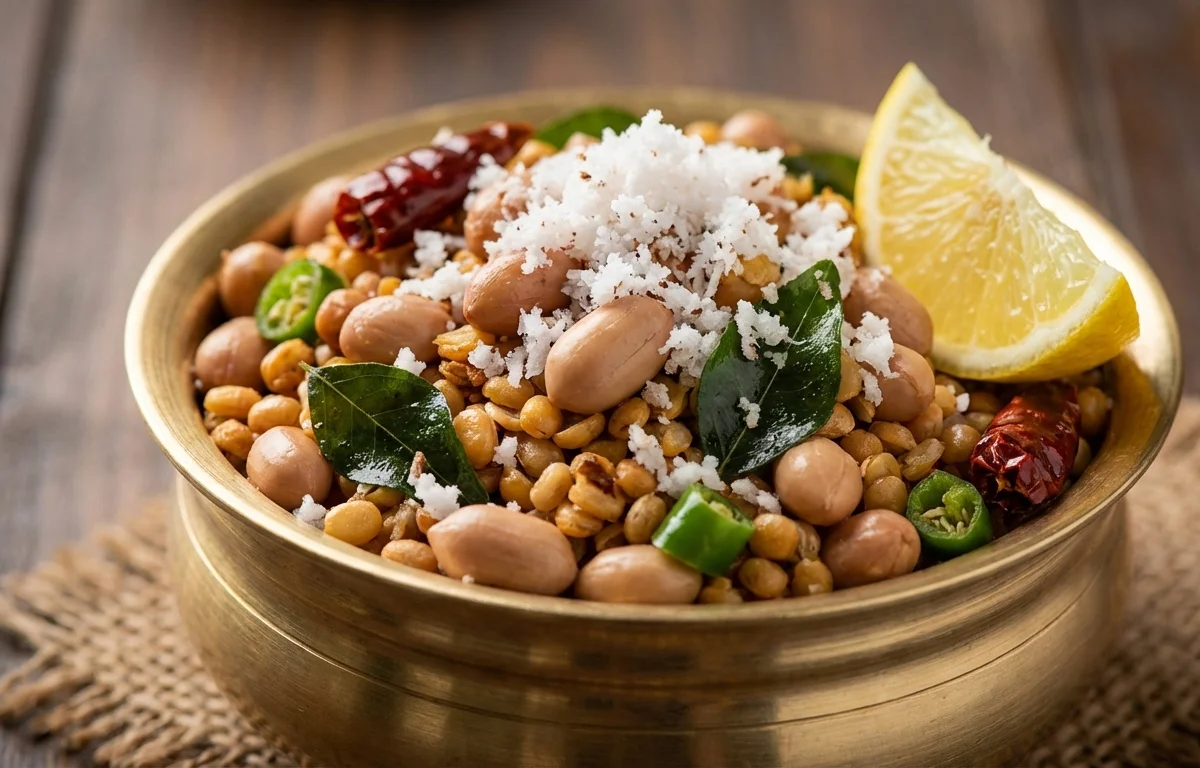
Peanut Sundal
A classic South Indian snack made with boiled peanuts, a fragrant tempering of spices, and fresh coconut. This verkadalai sundal is a protein-packed, savory treat, especially popular during festivals like Navaratri.
For 4 servings
Soak and Cook Peanuts
- Rinse the raw peanuts under running water. Place them in a large bowl and cover with 4 cups of water.
- Soak the peanuts for at least 6-8 hours, or overnight. This step is crucial for even cooking.
- Drain the soaking water. Transfer the peanuts to a pressure cooker, add 3 cups of fresh water and 1 teaspoon of salt.
- Secure the lid and pressure cook on medium heat for 4-5 whistles, or about 15-20 minutes, until the peanuts are tender but not mushy.
- Allow the pressure to release naturally. Drain any excess water and set the cooked peanuts aside.
Prepare the Tempering (Tadka)
- Heat coconut oil in a heavy-bottomed pan (kadai) over medium heat.
- Once the oil is hot, add the mustard seeds and let them splutter completely.
- Add the urad dal and sauté for about 30-40 seconds until it turns a light golden brown. Be careful not to burn it.
- Add the broken dried red chilies, hing, curry leaves, and finely chopped green chili. Sauté for another 30 seconds until the curry leaves are crisp and the mixture is fragrant.
- If using, add the turmeric powder and give it a quick stir.
Combine and Finish
- Add the boiled and drained peanuts to the pan with the tempering.
- Add the remaining 1/2 teaspoon of salt (or to taste) and mix everything together gently but thoroughly, ensuring the peanuts are well-coated with the spices.
- Sauté for 2-3 minutes, allowing the peanuts to absorb the flavors of the tempering.
- Turn off the heat. Stir in the freshly grated coconut and the lemon juice.
- Mix well one last time and serve immediately.
What to keep in mind.
5 tips from the recipe — small details that make a real difference to the final dish.
- 1For the best texture, do not overcook the peanuts. They should be soft enough to bite into easily but still retain their shape.
- 2Using fresh, not frozen or desiccated, grated coconut will give the most authentic and delicious flavor.
- 3Don't skip the hing (asafoetida) as it adds a unique savory flavor and aids in the digestion of legumes.
- 4Adjust the number of green and red chilies to suit your preferred spice level.
- 5Always add the lemon juice after turning off the heat to preserve its fresh taste and vitamin C content.
Adapt it for your goals.
Flavor
Add 1/2 teaspoon of sambar powder or rasam powder along with the tempering for a different flavor profile.
IngredientIngredient
For a tangy twist, add 2-3 tablespoons of finely chopped raw mango (when in season) along with the coconut at the end.
LegumeLegume
This recipe can be adapted for other legumes like chickpeas (chana), black-eyed peas (lobia), or whole green gram (moong).
GarnishGarnish
Garnish with finely chopped fresh cilantro (coriander leaves) for extra freshness and color.
Why this is on our healthy list.
Rich in Plant-Based Protein
Peanuts are an excellent source of protein, which is essential for muscle repair, growth, and overall body function. A single serving provides a significant protein boost, making it a great snack for vegetarians and vegans.
Heart-Healthy Fats
This dish is rich in monounsaturated and polyunsaturated fats from peanuts and coconut oil. These healthy fats can help lower bad cholesterol levels (LDL) and support cardiovascular health.
High in Dietary Fiber
The combination of peanuts and coconut provides a good amount of dietary fiber, which aids in digestion, promotes a feeling of fullness, and helps maintain stable blood sugar levels.
Energy Boosting
As a calorie-dense and nutrient-rich snack, Peanut Sundal provides a sustained release of energy, making it an ideal snack to combat midday slumps or for post-workout recovery.
Frequently asked questions
One serving of Peanut Sundal (approximately 1 cup) contains around 400-420 calories. It is a calorie-dense snack due to the peanuts and coconut, but it's packed with healthy fats, protein, and fiber that provide sustained energy.