
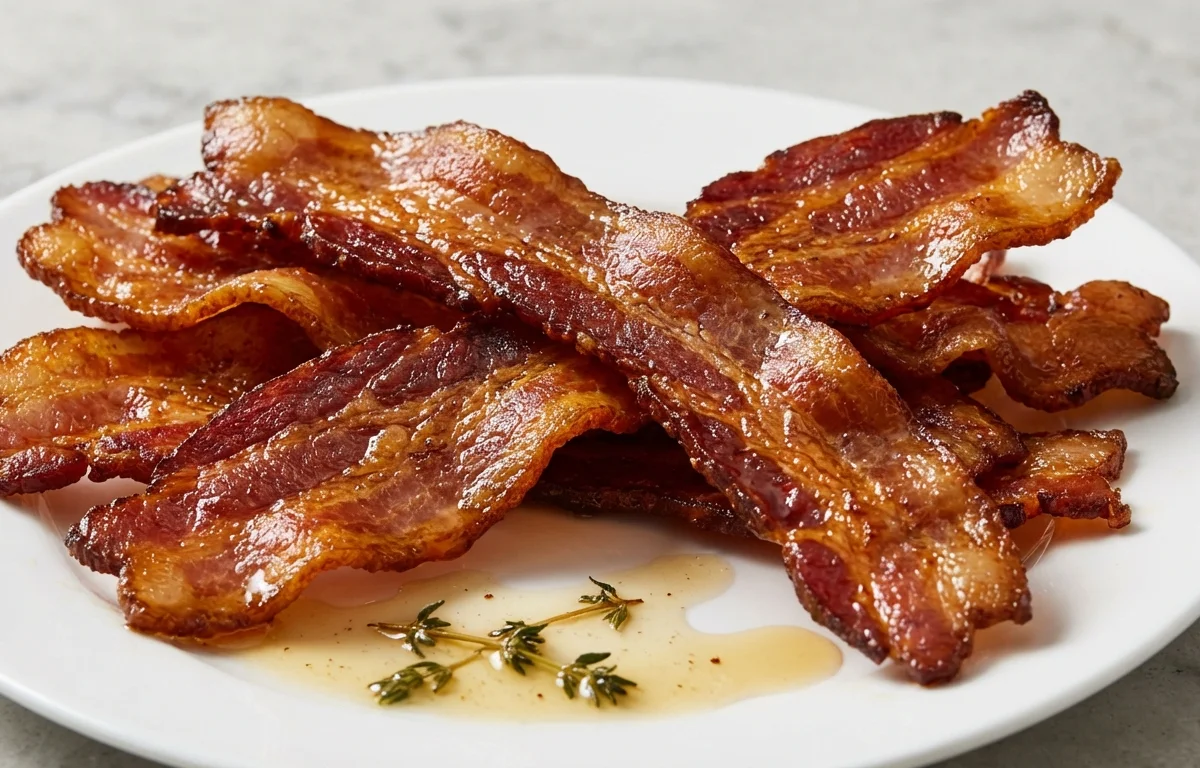
Pan-Fried Bacon
Master the art of making perfectly crispy, salty, and savory bacon strips in a skillet. This classic American breakfast staple is incredibly simple and fills your home with an irresistible aroma. The key is starting with a cold pan for perfectly rendered fat and an even cook.
For 4 servings
5 steps. 15 minutes total.
- 1
Step 1
- a.Prepare the Pan and Bacon
- b.Arrange the bacon strips in a single layer in a large, cold skillet (cast iron or non-stick works well).
- c.Do not overlap the strips to ensure even cooking. It is crucial to start with a cold pan to allow the fat to render slowly and evenly, which is the secret to crispy bacon.
- 2
Step 2
- a.Render the Fat
- b.Place the skillet on the stove over medium-low heat.
- c.Cook for 8-10 minutes without moving the strips. As the pan heats up, the fat will slowly render out. The bacon will start to sizzle and become translucent before it begins to brown.
- 3
Step 3
- a.Flip and Finish Cooking
- b.Using tongs, carefully flip each strip of bacon. Be cautious of hot, splattering grease.
- c.Continue to cook for another 5-7 minutes on the second side, or until the bacon reaches your desired level of crispiness. The bacon will continue to crisp up as it cools on the paper towel.
- 4
Step 4
- a.Drain and Serve
- b.Once cooked to perfection, use tongs to transfer the bacon strips to a plate lined with paper towels to absorb excess grease.
- c.Let it rest for a minute before serving warm.
- 5
Step 5
- a.Save the Bacon Fat (Optional)
- b.Let the skillet cool slightly. Carefully pour the rendered bacon fat through a fine-mesh sieve into a heat-safe container like a glass jar.
- c.Allow it to cool completely before sealing and storing in the refrigerator for up to 3 months. Use it for frying eggs, roasting vegetables, or making cornbread.
What to keep in mind.
6 tips from the recipe — small details that make a real difference to the final dish.
- 1Start with a cold pan. This is the most important tip for perfectly rendered fat and evenly crispy bacon.
- 2Don't overcrowd the skillet. Cook in batches if necessary to ensure each strip has enough space to cook evenly.
- 3Cook low and slow. High heat can burn the bacon before the fat has a chance to render out.
- 4Never pour hot grease down the drain, as it can solidify and clog your pipes.
- 5For extra-flat bacon strips, you can use a bacon press or a second, smaller heavy pan placed on top of the bacon as it cooks.
- 6Watch it closely towards the end of cooking, as it can go from perfectly crispy to burnt in a matter of seconds.
Adapt it for your goals.
Sweet & Spicy Bacon
In the last 2-3 minutes of cooking, drain most of the grease, then sprinkle the bacon with a mix of 1 tablespoon of brown sugar and a pinch of cayenne pepper. Watch carefully to prevent burning.
Black Pepper BaconBlack Pepper Bacon
Before cooking, generously sprinkle the bacon strips with freshly cracked black pepper for a simple, peppery kick.
Maple Glazed BaconMaple Glazed Bacon
During the last 2 minutes of cooking, brush both sides of the bacon with pure maple syrup. Cook until the glaze is bubbly and caramelized.
Why this is on our healthy list.
Good Source of Protein
Bacon provides a significant amount of high-quality animal protein, which is essential for building and repairing tissues, muscle maintenance, and overall body function.
Rich in B Vitamins
Pork products like bacon are a good source of B vitamins, including thiamine (B1), niacin (B3), B6, and B12. These vitamins are crucial for energy metabolism, brain function, and the formation of red blood cells.
Contains Essential Minerals
Bacon contains important minerals like selenium, a powerful antioxidant, and phosphorus, which is vital for bone health and energy production. However, it is also high in sodium, which should be monitored.
Frequently asked questions
A serving of four strips of pan-fried bacon contains approximately 160-200 calories, depending on the thickness of the cut and how much fat is rendered out during cooking.