
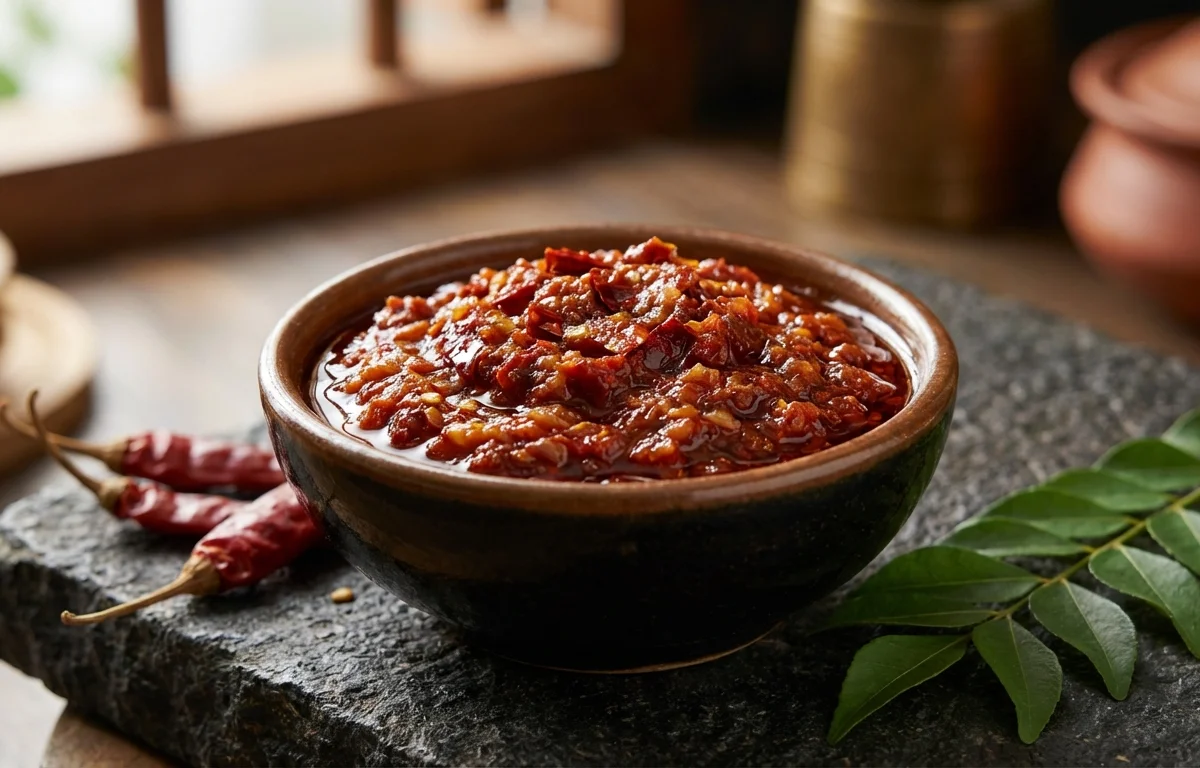
Mulaku Chammandi
A fiery and tangy Kerala-style chutney made with roasted red chilies, shallots, and tamarind. This traditional condiment is the perfect spicy accompaniment for rice gruel (kanji), dosa, or idli.
For 4 servings
Roast Chilies and Shallots
- Heat coconut oil in a small, heavy-bottomed pan over medium heat.
- Once the oil is hot, add both types of dried red chilies. Roast for 30-45 seconds, stirring continuously, until they puff up slightly and become aromatic. Be careful not to burn them, as this will make the chutney bitter.
- Remove the roasted chilies from the pan and set them aside on a plate to cool.
- In the same pan with the remaining oil, add the chopped shallots. Sauté for 4-5 minutes, stirring occasionally, until they become soft, translucent, and start to get golden brown at the edges.
Grind the Chutney
- Allow the roasted chilies and shallots to cool down completely to room temperature. This is important for getting the right texture.
- Transfer the cooled chilies, roasted shallots, tamarind paste, and salt to a small blender jar or a traditional stone grinder (ammikallu).
- Pulse a few times without adding any water first. This helps in breaking down the tough skins of the chilies effectively.
- Scrape down the sides of the jar.
Adjust Consistency and Serve
- Add 1 tablespoon of water and grind again to form a coarse paste. If the mixture is still too dry, add the second tablespoon of water and pulse until just combined.
- The final texture should be a thick, coarse, and semi-dry paste, not a smooth, runny chutney.
- Taste and adjust the salt if necessary.
- Transfer the Mulaku Chammandi to a serving bowl. For an enhanced aroma, you can drizzle a teaspoon of fresh, uncooked coconut oil over the top before serving. Serve with hot kanji (rice gruel), dosa, or idli.
What to keep in mind.
6 tips from the recipe — small details that make a real difference to the final dish.
- 1For the most authentic flavor, use high-quality virgin coconut oil.
- 2Adjust the ratio of Kashmiri to hot chilies to control the spice level and color.
- 3Roasting the shallots until they are nicely browned is crucial for developing a deep, savory flavor.
- 4Do not add too much water while grinding. This chutney is meant to be thick and coarse.
- 5If you have a traditional stone grinder (ammikallu), use it for the best texture and taste.
- 6A small drizzle of fresh, uncooked coconut oil over the chutney just before serving elevates its aroma and taste significantly.
Adapt it for your goals.
With Coconut
For a different texture and flavor, add 2-3 tablespoons of freshly grated coconut while grinding the chutney. This will make it a variation called 'Thenga Mulaku Chammandi'.
With GarlicWith Garlic
Add 2-3 cloves of garlic and roast them along with the shallots for a pungent, garlicky aroma and taste.
Smoked FlavorSmoked Flavor
For a traditional smoky flavor, char the red chilies directly over an open flame using tongs until they are fragrant and slightly blackened before grinding.
Why this is on our healthy list.
Rich in Antioxidants
Red chilies are packed with antioxidants like capsaicin, which helps combat oxidative stress. Shallots contain quercetin and kaempferol, further boosting its free-radical fighting properties.
Boosts Metabolism
The capsaicin in red chilies is known to have a thermogenic effect, which can temporarily increase metabolic rate and support the body's fat-burning process.
Anti-inflammatory Properties
Both capsaicin from chilies and sulfur compounds in shallots possess anti-inflammatory properties, which may help in reducing inflammation in the body.
Supports Heart Health
Shallots are a good source of allicin, which can help in managing cholesterol and blood pressure levels. When used in moderation, coconut oil can also be part of a heart-healthy diet.
Frequently asked questions
One serving of Mulaku Chammandi (about 2 tablespoons) contains approximately 65-75 calories, primarily from the coconut oil and shallots.