
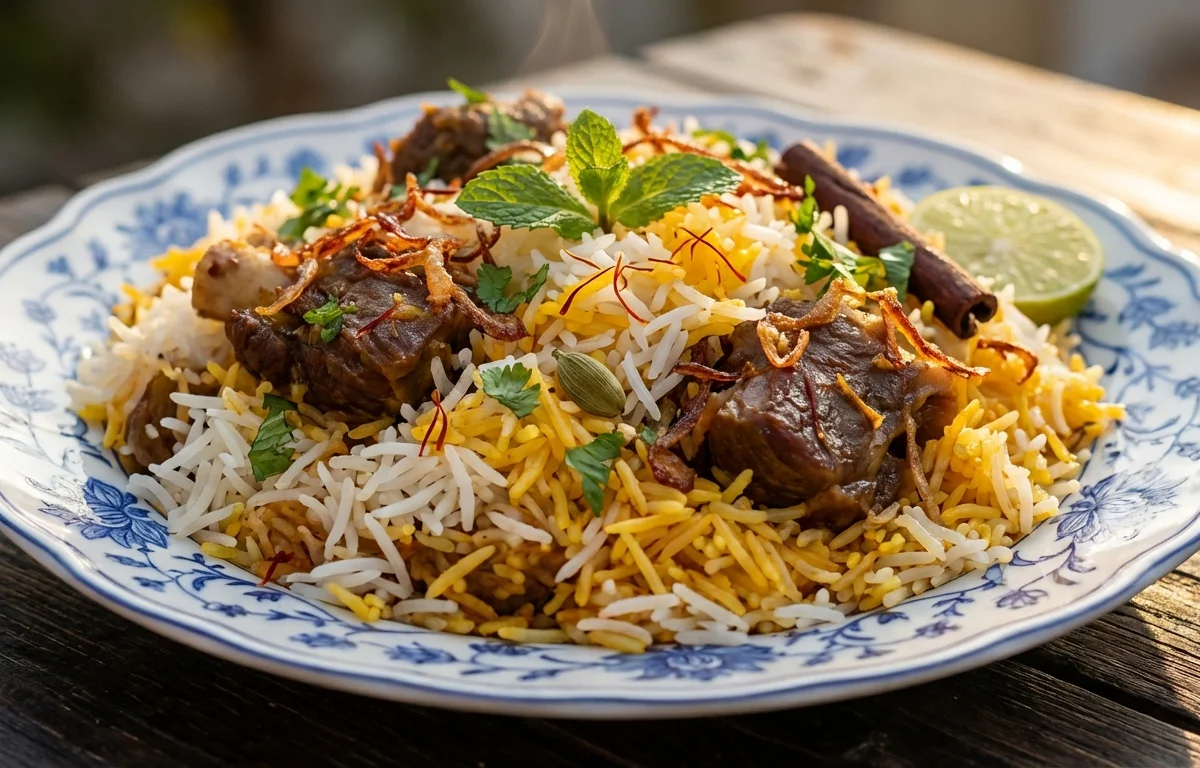
Lucknowi Mutton Biryani
Tender mutton and fragrant basmati rice slow-cooked in a sealed pot with aromatic spices. This Awadhi specialty is known for its delicate flavors and melt-in-the-mouth texture, a true royal feast.
For 6 servings
Preparation and Marination (1 hour 15 minutes)
- Wash the basmati rice 2-3 times until the water runs clear, then soak in water for 30 minutes. Drain completely before cooking.
- In a large bowl, combine the mutton pieces with whisked curd, ginger paste, garlic paste, and 1.5 tsp of salt. Mix thoroughly, cover, and let it marinate for at least 1 hour, or preferably overnight in the refrigerator.
- In a small bowl, soak the saffron strands in 3 tbsp of warm milk and set aside.
Create the Yakhni (Mutton Stock) (1 hour 20 minutes)
- Place all whole spices for the potli (coriander seeds, fennel seeds, peppercorns, 6 cloves, 6 green cardamoms, black cardamoms, cinnamon, mace, star anise, 2 bay leaves) on the muslin cloth and tie it into a tight pouch (potli).
- Heat 4 tbsp of ghee in a heavy-bottomed pot (handi). Add the sliced onions and fry on medium heat until they are golden brown and crisp (birista). Remove half of the fried onions and set them aside for layering.
- In the same pot with the remaining onions, add the marinated mutton. Sear on high heat for 5-7 minutes until the mutton is browned on all sides.
- Add the prepared potli masala and 4 cups of water. Bring to a boil, then reduce the heat to low. Cover and simmer for 60-75 minutes, or until the mutton is tender and falling off the bone.
- Once cooked, carefully remove the mutton pieces. Strain the remaining liquid (this is the yakhni) into a bowl and discard the potli. You should have about 1.5 to 2 cups of yakhni.
Parboil the Rice (10 minutes)
- In a large pot, bring 8 cups of water to a rolling boil. Add 2 tsp salt, 3 cloves, 3 green cardamoms, and 1 bay leaf.
- Add the soaked and drained rice. Cook for 5-7 minutes until the rice is exactly 70% cooked. The grain should break easily when pressed but still have a firm, raw core.
- Immediately drain the rice in a colander and spread it on a plate to prevent further cooking.
Layer the Biryani (5 minutes)
- In the same heavy-bottomed handi, spread half of the parboiled rice to form the base layer.
- Arrange the cooked mutton pieces evenly over the rice.
- Sprinkle half of the reserved fried onions (birista), half of the chopped mint, and half of the chopped coriander leaves over the mutton.
- Gently spread the remaining rice over the mutton to form the top layer.
- Garnish the top with the remaining fried onions, mint, and coriander leaves.
Prepare for Dum Cooking (5 minutes)
- Pour the strained yakhni evenly over the top layer of rice.
- Drizzle the saffron-infused milk, kewra water, rose water, and the remaining 2 tbsp of melted ghee all over the rice.
- In a bowl, mix the atta with about 1/2 cup of water to form a firm, pliable dough. Roll it into a long rope.
Cook on Dum (35 minutes)
- Apply the dough rope along the rim of the handi. Press the lid down firmly to create a perfect airtight seal.
- Place the sealed handi on the stove over high heat for the first 5 minutes to build up steam.
- Then, place a flat tawa (griddle) on the stove, reduce the heat to the lowest possible setting, and place the handi on the tawa. Cook on 'dum' for 20-25 minutes.
- Turn off the heat and let the biryani rest, still sealed, for at least 10 minutes. This allows the flavors to meld and the rice to settle.
Serve the Biryani (5 minutes)
- Carefully break the dough seal and open the lid, allowing the fragrant steam to escape.
- Use a long fork or a thin spatula to gently fluff the rice from the sides, mixing the layers lightly to ensure each serving gets both rice and mutton without breaking the delicate grains.
- Serve the Lucknowi Mutton Biryani hot with a side of cooling raita or a simple salad.
What to keep in mind.
6 tips from the recipe — small details that make a real difference to the final dish.
- 1Use good quality, aged long-grain basmati rice for the best texture and aroma.
- 2The 70% cooking mark for the rice is crucial. Overcooking it will result in a mushy biryani.
- 3Using a heavy-bottomed pot (handi) is essential to prevent the biryani from burning at the bottom during the dum process.
- 4Ensure the pot is sealed perfectly. A tight seal is the secret to a fragrant and flavorful dum biryani.
- 5Let the biryani rest for at least 10-15 minutes after dum cooking. This step is vital for the flavors to settle and the rice grains to firm up.
- 6Always use bone-in mutton for biryani, as the bones release collagen and marrow, adding immense flavor and richness to the yakhni (stock).
Adapt it for your goals.
Protein Swap
Replace mutton with bone-in chicken pieces. Reduce the cooking time for the chicken yakhni to about 30-35 minutes.
VegetarianVegetarian
For a vegetarian version, use a combination of paneer, large chunks of potatoes, carrots, and cauliflower. Marinate and cook them similarly, but with a much shorter cooking time.
Cooking MethodCooking Method
To save time, you can cook the mutton in a pressure cooker. Cook for 5-6 whistles on medium heat, then proceed with the layering and dum process as described.
Why this is on our healthy list.
Excellent Source of Protein
Mutton is a high-quality protein source, essential for building and repairing tissues, muscle growth, and overall body function.
Rich in Iron and B-Vitamins
Mutton provides heme iron, which is easily absorbed by the body and helps prevent anemia. It's also a good source of B-vitamins, particularly B12, which is vital for nerve function and red blood cell formation.
Digestive-Aiding Spices
The aromatic spices used in the potli masala, such as fennel, coriander, and cardamom, are traditionally known to have carminative properties that can aid digestion and reduce bloating.
Frequently asked questions
Dum Pukht is a traditional Awadhi slow-cooking technique where food is cooked in a sealed, heavy-bottomed pot (handi) over a very low flame. This method traps steam and aromas, allowing the ingredients to cook in their own juices and absorb the delicate flavors of the spices.