
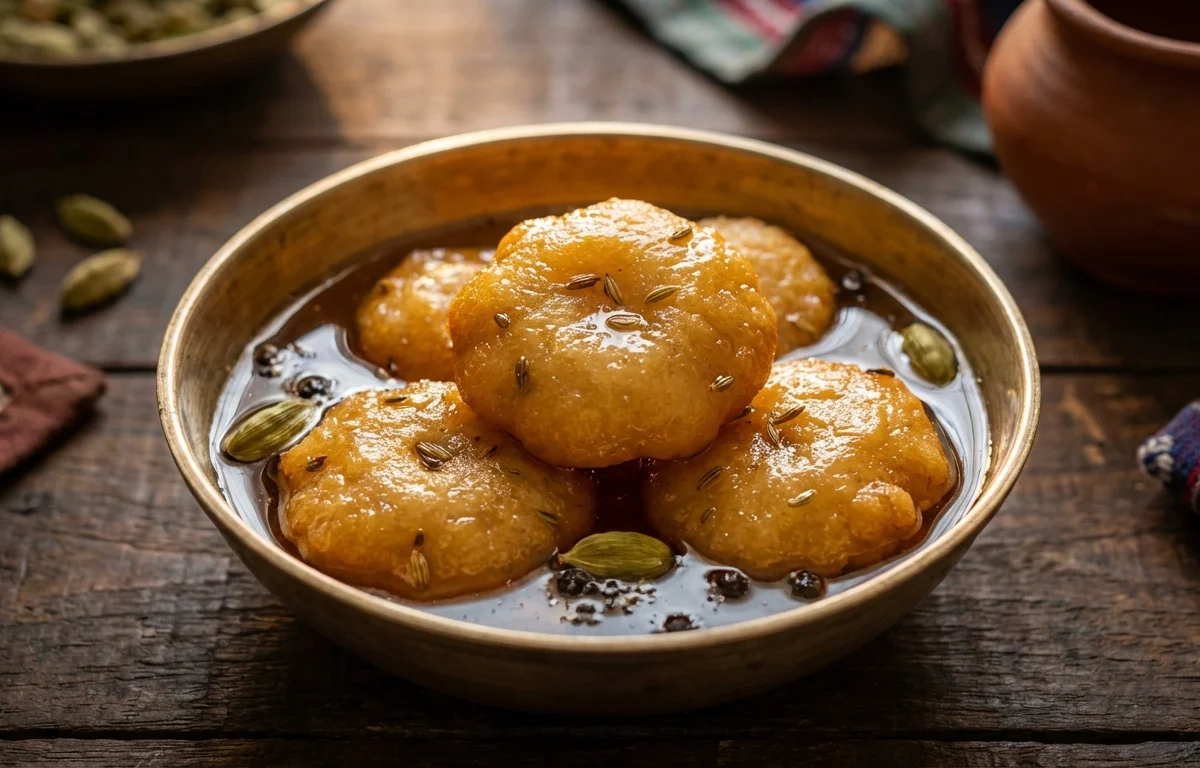
Kakada Jhola
A quintessential Odia dessert, Kakada Jhola features soft, spongy semolina fritters deep-fried to a perfect golden brown and then soaked in a fragrant, cardamom-infused sugar syrup. This delightful sweet treat is a staple during festivals and special celebrations in Odisha.
For 4 servings
Prepare the Semolina Dough
- In a heavy-bottomed pan, bring 1.5 cups of water to a rolling boil over medium heat.
- Add 2 tbsp sugar, ghee, fennel seeds, and salt. Stir until the sugar dissolves completely.
- Reduce the heat to low. Gradually add the fine rava while stirring continuously with a whisk or spatula to prevent any lumps from forming.
- Cook for 2-3 minutes, stirring constantly, until the mixture thickens into a smooth, non-sticky dough that pulls away from the sides of the pan.
- Turn off the heat, cover the pan with a lid, and let the dough rest and steam for 5-7 minutes. This makes it softer.
- Transfer the warm dough to a large plate or bowl. Add the all-purpose flour. Knead for 3-4 minutes until you have a smooth and pliable dough. Be careful as it will be hot.
Shape and Fry the Kakada
- While the dough is resting, heat the oil for deep frying in a kadai or deep pan over medium flame.
- Grease your palms with a little ghee or oil. Divide the dough into 12 equal portions and roll each portion into a smooth, crack-free ball.
- Gently flatten each ball between your palms to form a small, thick disc (pitha), about 2 inches in diameter.
- To check if the oil is ready, drop a tiny piece of dough into it. It should sizzle and rise to the surface steadily. If it browns too quickly, the oil is too hot.
- Carefully slide 3-4 kakadas into the hot oil, ensuring not to overcrowd the pan.
- Fry on a consistent medium-low heat for 6-8 minutes, flipping them occasionally, until they are evenly golden brown and cooked through.
- Once fried, use a slotted spoon to remove the kakadas and place them on a wire rack or paper towel to drain excess oil.
Prepare the Sugar Syrup (Jhola)
- In a separate wide saucepan, combine 1 cup of sugar and 2 cups of water.
- Bring the mixture to a boil over medium heat, stirring until the sugar has completely dissolved.
- Add the lightly crushed green cardamom pods and the optional black peppercorns.
- Reduce the heat and let the syrup simmer for 5-7 minutes. It should thicken slightly and feel a bit sticky between your fingers, but it should not reach a one-string consistency.
- Turn off the heat and keep the syrup warm.
Soak and Serve
- Ensure the sugar syrup is warm (not boiling hot). If it has cooled down, gently reheat it.
- Gently drop the freshly fried, warm kakadas into the warm sugar syrup.
- Press them down gently with a spoon to ensure they are fully submerged.
- Let the kakadas soak for a minimum of 2 hours, or up to 4 hours for the best result, allowing them to absorb the syrup and become soft and juicy.
- Serve the Kakada Jhola warm or at room temperature.
What to keep in mind.
6 tips from the recipe — small details that make a real difference to the final dish.
- 1Use fine rava (semolina) for a smoother, melt-in-the-mouth texture.
- 2Knead the dough while it is still warm to ensure it is smooth and crack-free. This prevents the kakadas from breaking while frying.
- 3Fry the kakadas on a consistent medium-low flame. Frying on high heat will brown the outside quickly while leaving the inside raw.
- 4The temperature of both the kakadas and the syrup is crucial. Both should be warm for optimal absorption. If kakadas are cold, the syrup should be hot, and vice-versa.
- 5Do not overcook the sugar syrup. A sticky consistency is perfect; a thick, stringy syrup will not be absorbed properly.
- 6For a richer flavor, you can add a few strands of saffron to the sugar syrup.
Adapt it for your goals.
Stuffed Kakada
Create a filling with 1/2 cup grated coconut, 2 tbsp jaggery or sugar, and 1/4 tsp cardamom powder. Place a small amount of this filling in the center of each dough disc before sealing and frying.
Jaggery SyrupJaggery Syrup
Replace the 1 cup of sugar for the syrup with 1 cup of grated or powdered jaggery for a more traditional and earthy flavor. Strain the jaggery syrup before use to remove impurities.
Nutty GarnishNutty Garnish
Garnish the soaked Kakada Jhola with slivered almonds, pistachios, or chopped cashews before serving for added texture and richness.
Why this is on our healthy list.
Provides Energy
Semolina (rava) is a good source of carbohydrates, which provide a quick and sustained energy boost, making this dessert a rich source of energy.
Aids Digestion
The inclusion of aromatic spices like fennel seeds and cardamom is not just for flavor. Traditionally, these spices are known to aid digestion and prevent bloating.
Source of Healthy Fats
Ghee, used in the dough, is a source of healthy saturated fats and fat-soluble vitamins like A, E, and D when consumed in moderation.
Frequently asked questions
This can happen for a few reasons: the dough was not kneaded well, it was too dry, or the kakadas were fried on high heat. Also, if the sugar syrup was too thick (one-string consistency or more), it won't be absorbed, leaving the kakadas hard.