
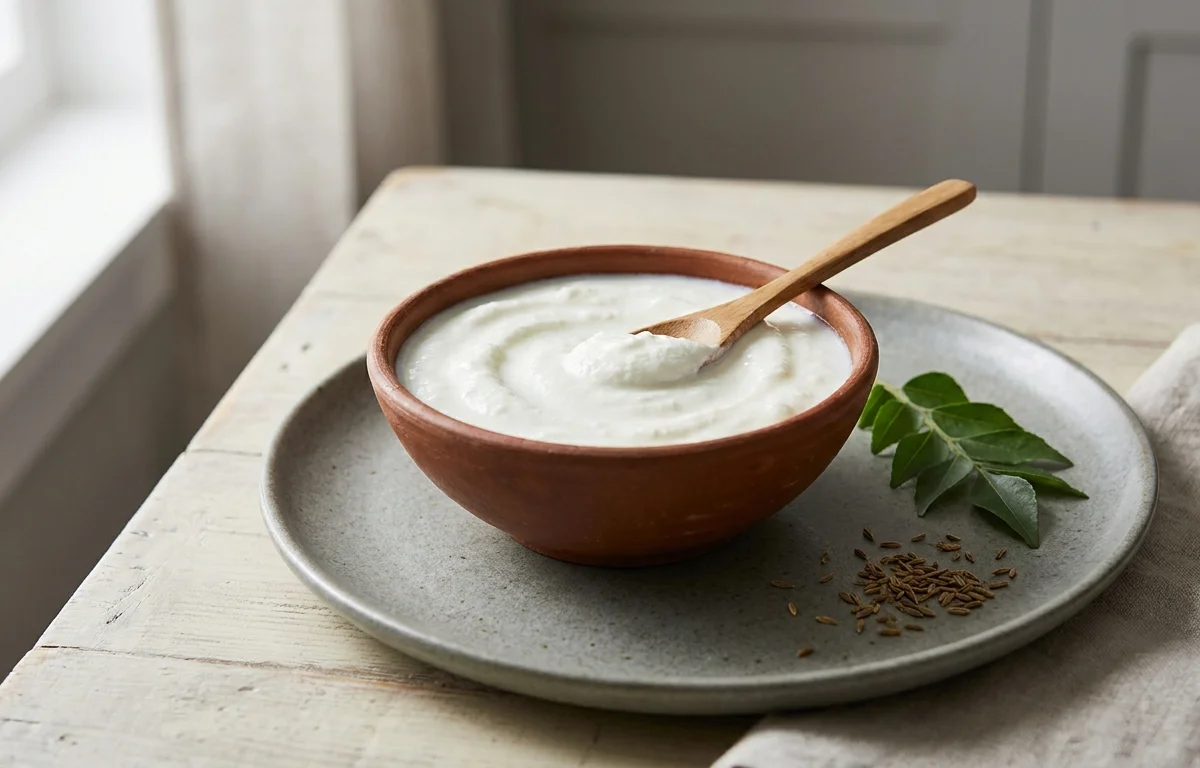
Plain Curd
Creamy, tangy, and rich in probiotics, this homemade plain curd is the perfect cooling accompaniment to any Indian meal. Making your own dahi is simple and rewarding!
For 4 servings
Heat the milk.
Pour the milk into a clean, heavy-bottomed pot. Bring it to a gentle boil over medium heat, stirring occasionally to prevent it from sticking to the bottom. Once it boils, turn off the heat.
TIPBoiling the milk helps to kill any unwanted bacteria and denature the proteins, which results in a thicker curd.Cool the milk to lukewarm.
Let the milk cool down until it is lukewarm. You should be able to comfortably dip a clean finger into it for a few seconds. The ideal temperature is around 40-45°C (105-115°F).
TIPIf the milk is too hot, it will kill the live cultures in the starter. If it's too cold, the curd won't set properly.Prepare the starter culture.
- In a small bowl, add the yogurt starter.
- Whisk it well until it's smooth and free of lumps.
- Add 2-3 tablespoons of the warm milk to the starter and mix everything together. This helps to temper the starter.
Combine and prepare for setting.
Pour the starter mixture into the pot with the rest of the lukewarm milk. Stir gently just a few times to distribute the culture evenly.
Let the curd ferment.
Cover the pot with a lid and place it in a warm, draft-free spot to set. This can be inside a turned-off oven, a microwave, or wrapped in a thick towel. Let it sit undisturbed for 6 to 8 hours.
TIPAvoid moving or shaking the pot while the curd is setting, as this can result in a watery texture.Chill the curd.
Once the curd is set (it should be firm and not jiggle), transfer it to the refrigerator. Chill for at least 2 hours. This stops the fermentation process and helps the curd to firm up further.
Serve chilled.
Serve the homemade plain curd chilled as a side with your favorite meals like khichdi, biryani, or parathas.
What to keep in mind.
5 tips from the recipe — small details that make a real difference to the final dish.
- 1For a thicker, more 'malai' (creamy) top layer, don't stir the milk too much after it boils and cools.
- 2The setting time varies with the climate. In summer, it may set in 4-6 hours, while in winter it could take 8-12 hours.
- 3Always use a fresh, clean, and dry spoon to take curd from the container to prevent it from turning sour.
- 4Don't forget to save a tablespoon of your homemade curd to use as a starter for the next batch.
- 5If your curd turns out sour, it means it was left to ferment for too long. Refrigerate it as soon as it sets.
Why this is on our healthy list.
Rich in Probiotics
Homemade curd is packed with live and active cultures that promote a healthy gut microbiome, improve digestion, and boost immunity.
Excellent Source of Protein
It provides a good amount of high-quality protein, which is essential for building and repairing tissues, and helps in keeping you full.
High in Calcium
Curd is a great source of calcium, which is vital for maintaining strong bones and teeth, as well as for proper nerve and muscle function.
Cooling for the Body
In traditional Indian medicine, curd is known to have a cooling effect on the body, making it a perfect accompaniment for spicy meals.
Frequently asked questions
Yes, homemade curd is very healthy. It's an excellent source of probiotics for gut health, provides high-quality protein for muscle maintenance, and is rich in calcium for strong bones.