
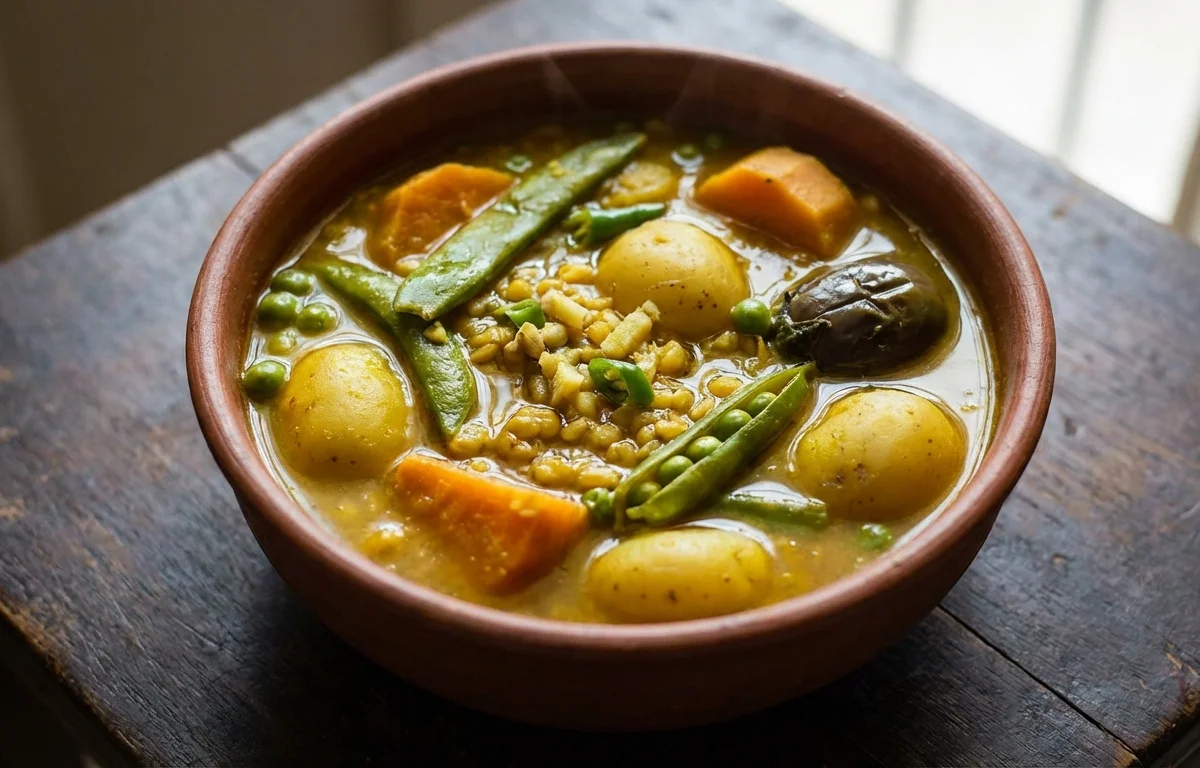
Gota Sheddho
A traditional Bengali one-pot meal of whole vegetables and lentils, gently boiled to perfection. This rustic, healthy dish is a staple during Saraswati Puja and is best enjoyed with a drizzle of pungent mustard oil.
For 4 servings
3 steps. 25 minutes total.
- 1
Step 1
- a.Prepare the Ingredients (15 mins)
- b.Rinse the whole moong dal under cold running water until the water runs clear. Drain well.
- c.Thoroughly scrub the baby potatoes and sweet potato. Do not peel them. Keep the baby potatoes whole and cut the sweet potato into two large chunks.
- d.Wash the baby brinjals, keeping their green stalks intact. Wash the hyacinth beans (sheem) and trim the tough ends. Wash the green pea pods.
- 2
Step 2
- a.Combine and Pressure Cook (25 mins)
- b.Place the rinsed moong dal in a 5-liter pressure cooker.
- c.Layer all the washed whole vegetables on top of the dal: baby potatoes, sweet potato, baby brinjals, hyacinth beans, and pea pods.
- d.Add the whole piece of ginger and the whole green chilies.
- e.Sprinkle the turmeric powder and salt over the ingredients.
- f.Pour in 4 cups of water. The water should just cover the ingredients.
- g.Secure the lid of the pressure cooker. Cook on medium-high heat for 3 to 4 whistles.
- h.After the whistles, turn off the heat and let the pressure release naturally. This is crucial to ensure the vegetables are cooked through but not mushy.
- 3
Step 3
- a.Serve (5 mins)
- b.Once the pressure has fully released, carefully open the cooker.
- c.The dal and vegetables should be perfectly cooked and soft, yet holding their shape.
- d.Gently stir the mixture once, being careful not to break the vegetables.
- e.Serve the Gota Sheddho warm in bowls. Just before eating, drizzle generously with raw mustard oil for its characteristic pungent aroma and flavor.
What to keep in mind.
5 tips from the recipe — small details that make a real difference to the final dish.
- 1Use small, seasonal vegetables for the most authentic taste and texture.
- 2Do not skip the natural pressure release step; it prevents the vegetables from disintegrating.
- 3The pungent flavor of raw mustard oil is the soul of this dish. Use a good quality, cold-pressed oil.
- 4Gota Sheddho tastes even better the next day as the flavors meld together. It can be enjoyed cold or gently reheated.
- 5For an Instant Pot, cook on high pressure for 10 minutes, followed by a full natural pressure release.
Adapt it for your goals.
Vegetable Variations
Incorporate other small, whole vegetables like small radishes (mulo), whole broad beans (makhan sheem), or even small chunks of raw papaya.
Lentil VariationsLentil Variations
While whole moong is traditional, you can try making it with whole black gram (kala urad dal) for a different flavor and texture, though you may need to adjust cooking time.
Non Traditional TemperingNon-Traditional Tempering
For a different take, you can add a simple tempering (tadka) of cumin seeds and a pinch of asafoetida (hing) in ghee or mustard oil before serving. This is not traditional but adds a layer of flavor.
Why this is on our healthy list.
Rich in Plant-Based Protein
Whole moong dal is an excellent source of plant-based protein, which is essential for muscle repair, growth, and overall body function.
High in Dietary Fiber
The combination of whole lentils and unpeeled vegetables provides a substantial amount of dietary fiber, promoting digestive health, preventing constipation, and aiding in blood sugar regulation.
Promotes Gut Health
This simply boiled dish is easy to digest and free from heavy oils and spices, making it gentle on the digestive system. The fiber content also acts as a prebiotic, feeding beneficial gut bacteria.
Packed with Vitamins and Minerals
The variety of vegetables like sweet potatoes, peas, and beans ensures a wide range of essential vitamins (like Vitamin A and C) and minerals (like potassium and iron).
Frequently asked questions
Gota Sheddho is traditionally prepared in Bengali households on the day of Saraswati Puja, the festival celebrating the goddess of knowledge. It is eaten on the following day, known as 'Shital Shashti', and is consumed cold as a part of the custom of eating 'panta bhat' (fermented rice).