
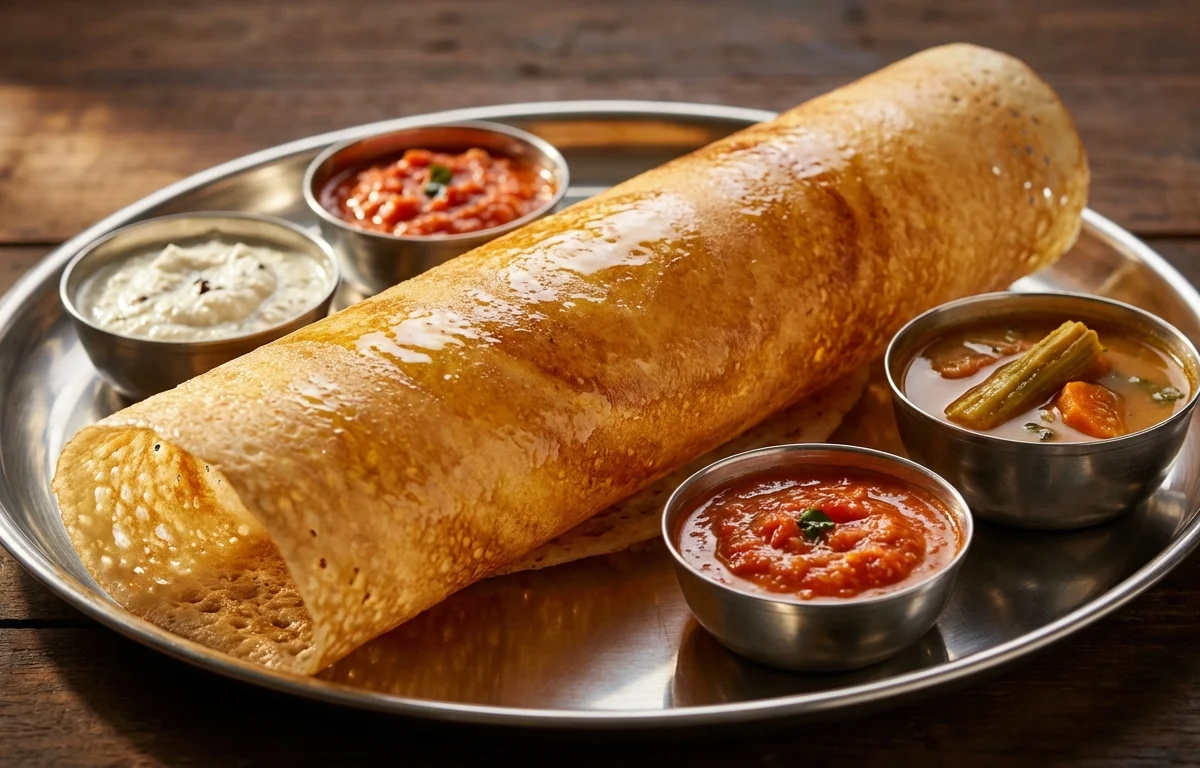
Ghee Roast Dosa
A quintessential South Indian delight, this dosa is roasted to a perfect golden-brown crispiness using generous amounts of ghee. Its rich, buttery flavor and paper-thin texture make it an irresistible meal, especially when paired with sambar and chutney.
For 4 servings
5 steps. 30 minutes total.
- 1
Step 1
- a.Prepare the Batter (5 minutes)
- b.Ensure your dosa batter is at room temperature. If it was refrigerated, let it sit out for at least 30 minutes.
- c.Check the consistency. It should be smooth and pourable, but not watery. If too thick, add water one tablespoon at a time and mix gently until it resembles a thin pancake batter.
- d.Stir in the salt (if needed) and optional sugar. The sugar helps achieve a beautiful golden-brown color.
- 2
Step 2
- a.Heat and Season the Tawa (5 minutes)
- b.Place a cast-iron or heavy-bottomed non-stick tawa (griddle) over medium-high heat. Let it get very hot.
- c.Test the heat by sprinkling a few drops of water on it. If they sizzle and evaporate instantly, the tawa is ready.
- d.Dip the cut side of the half onion into a small bowl of vegetable oil. Rub the oiled onion firmly all over the tawa surface. This seasons the pan and prevents the dosa from sticking.
- 3
Step 3
- a.Spread and Cook the Dosa (3-4 minutes per dosa)
- b.Reduce the heat to medium-low. This is crucial for spreading the batter thinly without it cooking instantly.
- c.Pour a ladleful (about 1/4 cup) of batter onto the center of the hot tawa.
- d.Working quickly, use the back of the ladle to spread the batter in continuous, concentric circles, moving from the center outwards to form a large, thin circle.
- e.Increase the heat back to medium-high. Drizzle 1-2 tablespoons of melted ghee evenly over the surface and around the edges of the dosa.
- f.Cook for about 2-3 minutes, or until the bottom turns a deep golden-brown, the surface looks cooked, and the edges start to lift away from the tawa.
- 4
Step 4
- a.Fold and Serve
- b.Once crisp and golden, use a thin spatula to gently fold the dosa in half, or roll it into a cylinder or a cone shape.
- c.Immediately transfer the hot ghee roast dosa to a serving plate.
- d.Serve right away with accompaniments like sambar, coconut chutney, and tomato chutney for the authentic experience.
- 5
Step 5
- a.Repeat for Remaining Dosas
- b.Before making the next dosa, slightly cool the tawa by wiping it with a damp cloth or paper towel. This prevents the next dosa from sticking and allows for easy spreading.
- c.Re-grease the tawa with the oiled onion if necessary.
- d.Repeat the process from Step 3 until all the batter is used.
What to keep in mind.
6 tips from the recipe — small details that make a real difference to the final dish.
- 1For the crispiest dosa, your tawa must be very hot before pouring the batter, but slightly cooled down just as you spread it.
- 2A well-seasoned cast-iron tawa is highly recommended for achieving a restaurant-style texture and color.
- 3The consistency of the batter is key. It should be like a crepe batter – not too thick, not too thin.
- 4Don't be shy with the ghee. It's the star ingredient that provides the signature flavor and crispiness.
- 5If your batter is not spreading easily, it means the tawa is too hot. Wipe it with a damp cloth to cool it down slightly.
- 6Serve immediately. Ghee roast dosas lose their crispness quickly as they cool.
Adapt it for your goals.
Masala Dosa
Add a spoonful of spiced potato filling (aloo masala) in the center of the dosa before folding it.
Podi DosaPodi Dosa
After drizzling ghee, sprinkle a generous amount of 'milagai podi' (spicy lentil powder) over the dosa while it's cooking.
Cheese DosaCheese Dosa
For a modern twist, sprinkle grated mozzarella or cheddar cheese over the dosa after spreading the batter. Fold and serve once the cheese is melted.
Onion DosaOnion Dosa
Sprinkle finely chopped onions over the batter immediately after spreading it on the tawa. Press them gently with the spatula and proceed with the recipe.
Why this is on our healthy list.
Promotes Gut Health
The dosa batter is fermented, a process that introduces beneficial probiotics. These microorganisms support a healthy gut microbiome, aiding digestion and improving nutrient absorption.
Provides Sustained Energy
Made from rice and lentils, dosa is a good source of complex carbohydrates, which are broken down slowly by the body, providing a steady and sustained release of energy.
Source of Healthy Fats
Ghee is rich in healthy saturated fats and fat-soluble vitamins like A, E, and D. When consumed in moderation, it can support brain health and provide essential nutrients.
Frequently asked questions
A non-crispy dosa is usually due to three things: incorrect tawa temperature (too low), thick batter, or not enough fat (ghee/oil). Ensure your tawa is very hot, your batter is of a thin, pourable consistency, and you use enough ghee.