
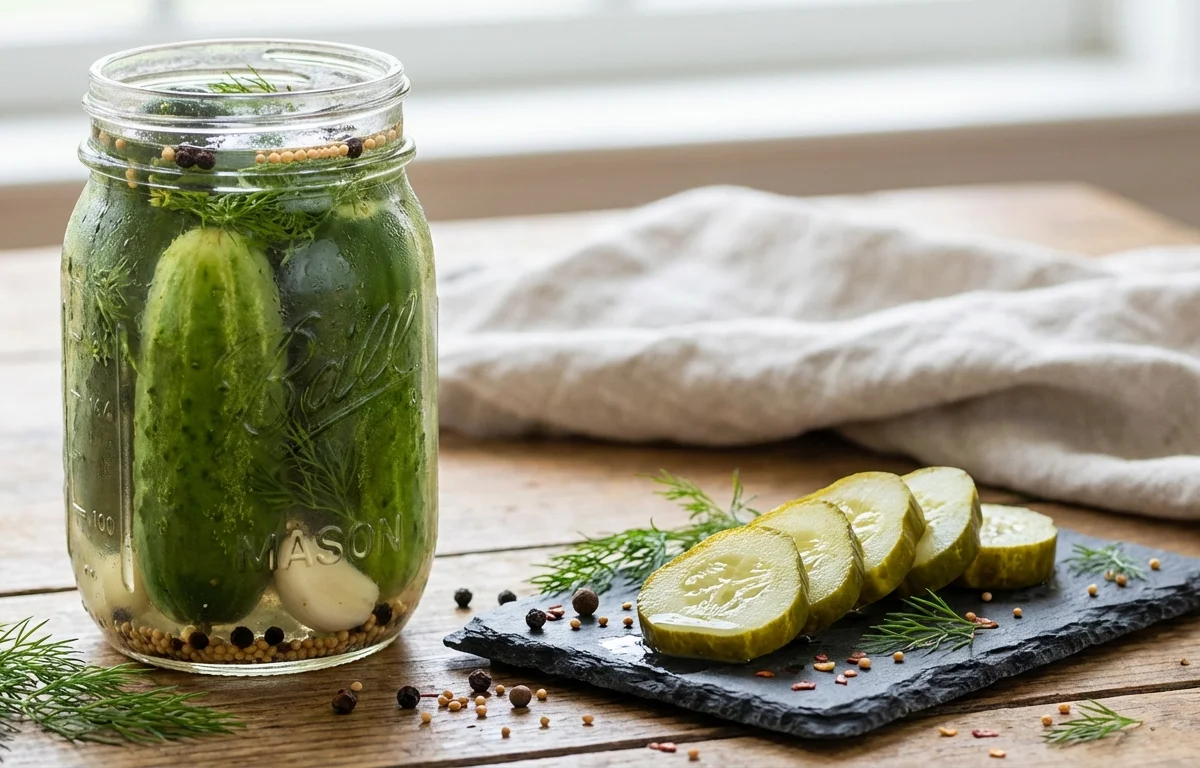
Dill Pickles
Create exceptionally crisp, tangy, and flavorful homemade dill pickles with this classic canning recipe. Packed with fresh dill and garlic, these pickles are a superior alternative to store-bought versions and the perfect crunchy addition to sandwiches, burgers, or as a standalone snack.
For 32 servings
7 steps. 25 minutes total.
- 1
Step 1
- a.Sterilize Jars and Lids (15 minutes)
- b.Wash 4 quart-sized canning jars, lids, and rings in hot, soapy water and rinse well.
- c.Place the jars on a rack in a large water bath canner or stockpot. Cover with water by at least 1 inch and bring to a simmer (180°F/82°C). Keep jars hot until ready to use to prevent cracking.
- d.Place lids and rings in a small saucepan of hot water; do not boil. Keep them warm.
- 2
Step 2
- a.Prepare the Cucumbers (15 minutes)
- b.Thoroughly wash cucumbers under cold running water, gently scrubbing away any spines or dirt.
- c.Trim 1/16th of an inch from the blossom end of each cucumber. This end contains an enzyme that can cause mushy pickles.
- d.For extra crispness, submerge the trimmed cucumbers in an ice water bath for 30 minutes while you prepare other ingredients.
- e.Cut cucumbers into spears, slices, or leave whole as desired.
- 3
Step 3
- a.Pack the Jars (10 minutes)
- b.Carefully remove one hot jar at a time from the canner, pouring the water back into the pot.
- c.In the bottom of each jar, place 2 sprigs of fresh dill, 3 smashed garlic cloves, 1 tsp black peppercorns, 1 tsp mustard seeds, and 1/2 tsp red pepper flakes (if using).
- d.Tightly pack the prepared cucumbers into the jars, leaving a 1/2-inch headspace at the top.
- 4
Step 4
- a.Make the Pickling Brine (5 minutes)
- b.In a large non-reactive saucepan (stainless steel or enamel), combine the 4 cups of water, 4 cups of white vinegar, and 1/2 cup of pickling salt.
- c.Bring the mixture to a rolling boil over medium-high heat, stirring until the salt has completely dissolved.
- 5
Step 5
- a.Fill and Seal the Jars (5 minutes)
- b.Carefully ladle the hot brine into each packed jar, covering the cucumbers completely while maintaining the 1/2-inch headspace.
- c.Remove air bubbles by sliding a bubble remover tool or a thin wooden skewer around the inside of the jar.
- d.Wipe the jar rims with a clean, damp cloth to ensure a proper seal. Center the lid on the jar and screw on the ring until it is 'fingertip-tight'—just snug, not forced.
- 6
Step 6
- a.Process in Water Bath (20 minutes)
- b.Using a jar lifter, carefully place the sealed jars back into the canner. Ensure the water level is at least 1-2 inches above the tops of the jars, adding more boiling water if necessary.
- c.Cover the canner and bring the water to a full rolling boil.
- d.Once boiling, start a timer and process the jars for 10 minutes (for altitudes up to 1,000 ft).
- e.After 10 minutes, turn off the heat, remove the lid, and let the jars stand in the hot water for 5 more minutes to acclimate.
- 7
Step 7
- a.Cool, Check Seal, and Store
- b.Remove the jars from the canner and place them upright on a towel-lined countertop, leaving space between them to cool.
- c.Let the jars cool undisturbed for 12-24 hours. Do not tighten the rings. You should hear 'pinging' sounds as the lids seal.
- d.After 24 hours, check the seals. Press the center of each lid; if it does not flex up or down, the jar is sealed. Remove the rings, wipe the jars, label, and date them.
- e.Store sealed jars in a cool, dark place for at least 2 weeks to allow flavors to develop. They are best after 4-6 weeks and will keep for up to 18 months.
What to keep in mind.
7 tips from the recipe — small details that make a real difference to the final dish.
- 1For the crispiest pickles, use the freshest pickling cucumbers you can find, preferably harvested the same day.
- 2Trimming the blossom end is crucial as it contains an enzyme that can make pickles mushy.
- 3Always use pickling salt or kosher salt. Iodized table salt contains anti-caking agents that can make the brine cloudy and affect the taste.
- 4Do not overtighten the rings before processing; this can prevent air from escaping and may cause the seal to fail.
- 5Wait at least 2 weeks before opening a jar. This curing time allows the flavors to fully develop and mellow.
- 6Any jars that do not seal properly must be stored in the refrigerator and eaten within a few weeks.
- 7For canning at high altitudes, increase processing time: add 5 minutes for 1,001-6,000 ft and 10 minutes for above 6,000 ft.
Adapt it for your goals.
Spicy Dill Pickles
Add a whole dried chili pepper (like chile de árbol) or a sliced fresh jalapeño to each jar along with the red pepper flakes for extra heat.
Extra Garlic Dill PicklesExtra Garlic Dill Pickles
Increase the garlic to 5-6 cloves per jar for a more pungent, garlic-forward flavor.
Refrigerator Pickles (No Canning)Refrigerator Pickles (No Canning)
For a quicker version, skip the water bath processing (Step 6). Let the filled jars cool to room temperature, then store them in the refrigerator. They will be ready to eat in 2-3 days and will keep for about 2 months.
Why this is on our healthy list.
Supports Gut Health
The pickling process can encourage the growth of beneficial bacteria (probiotics), which are essential for maintaining a healthy digestive system.
Low in Calories
Made primarily from cucumbers and water, dill pickles are extremely low in calories and contain no fat, making them an excellent choice for weight management.
Source of Antioxidants
Cucumbers contain antioxidants, and the herbs and spices used in pickling, like dill and garlic, add to the antioxidant content, which helps protect the body from cellular damage.
Frequently asked questions
Mushiness is often caused by a few factors: using cucumbers that aren't fresh, not trimming the blossom end (which contains softening enzymes), using a brine that isn't hot enough, or over-processing the jars in the water bath.