
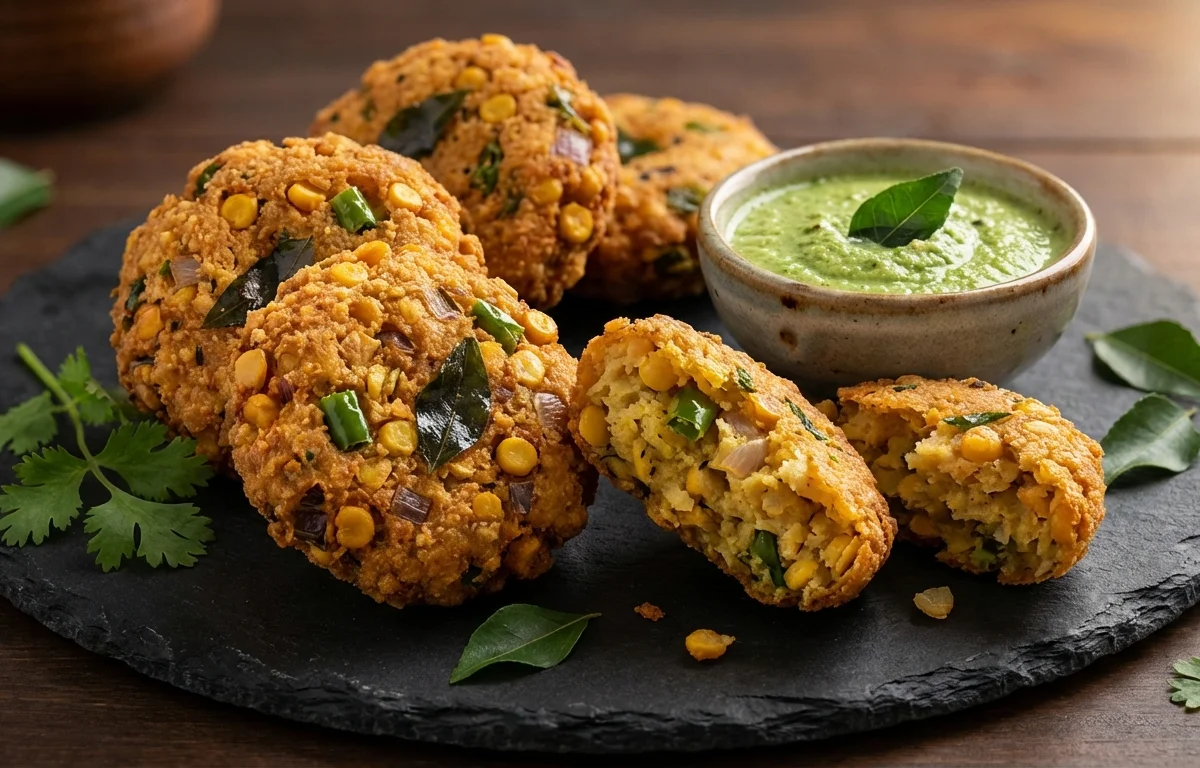
Dal Vada
Crispy, savory lentil fritters from South India, packed with onions, herbs, and spices. This popular tea-time snack is crunchy on the outside and soft on the inside, perfect with coconut chutney.
For 4 servings
6 steps. 20 minutes total.
- 1
Step 1
- a.Soak and Prepare the Dals
- b.Rinse the chana dal and toor dal thoroughly under running water.
- c.Soak them together in a bowl with ample water for 2 to 3 hours. Do not over-soak.
- d.Drain the water completely using a colander. Let the dals sit in the colander for 10-15 minutes to remove all excess moisture.
- e.Set aside 2 tablespoons of the whole soaked dal. This will be added later to give the vadas a crunchy texture.
- 2
Step 2
- a.Grind the Dal Batter
- b.Transfer the remaining drained dal to a grinder jar or food processor.
- c.Without adding any water, pulse in short bursts of 10-15 seconds each, scraping down the sides as needed.
- d.Grind to a thick, coarse paste. A grainy texture is crucial for crispy vadas; avoid making a smooth batter.
- 3
Step 3
- a.Create the Vada Mixture
- b.Transfer the ground dal paste to a large mixing bowl.
- c.Add the reserved whole soaked dal, finely chopped onion, green chillies, minced ginger, fennel seeds, chopped curry leaves, coriander leaves, hing, and salt.
- d.Mix everything together thoroughly with your hands until all the ingredients are evenly distributed.
- 4
Step 4
- a.Shape the Vadas
- b.Lightly grease your palms with a little oil to prevent sticking.
- c.Take a lemon-sized portion of the mixture and roll it into a ball.
- d.Gently flatten the ball between your palms to form a disc about 2 inches in diameter and 1/2 inch thick. The edges can be slightly rustic and uneven.
- 5
Step 5
- a.Deep Fry the Vadas
- b.Heat oil in a kadai or deep pan over a medium flame. To check if the oil is ready, drop a tiny piece of the mixture; it should sizzle and rise to the top steadily.
- c.Carefully slide 3-4 shaped vadas into the hot oil, ensuring not to overcrowd the pan.
- d.Fry for 3-4 minutes on one side until it becomes golden brown and crisp.
- e.Flip the vadas gently and fry the other side for another 3-4 minutes until they are evenly golden and cooked through.
- 6
Step 6
- a.Drain and Serve
- b.Once perfectly fried, remove the vadas from the oil using a slotted spoon.
- c.Place them on a plate lined with paper towels to absorb any excess oil.
- d.Serve the Dal Vadas hot with coconut chutney, tomato ketchup, or a cup of hot tea.
What to keep in mind.
6 tips from the recipe — small details that make a real difference to the final dish.
- 1The key to crispy vadas is a coarse batter. Avoid over-grinding the dal into a smooth paste.
- 2Ensure the dals are drained completely. Any excess water will result in oily and soggy vadas.
- 3Do not add any water while grinding. The moisture from the soaked dal is usually sufficient.
- 4Maintain a steady medium heat while frying. If the heat is too high, the vadas will brown quickly on the outside but remain raw inside.
- 5If your batter becomes too loose or watery, add 1-2 tablespoons of rice flour to help bind it together.
- 6Always test the oil temperature before frying. If the oil is not hot enough, the vadas will absorb too much oil.
Adapt it for your goals.
Karnataka Style (Sabsige Soppu Vade)
Add 1/4 cup of finely chopped fresh dill leaves (sabsige soppu) to the vada mixture for a distinct and aromatic flavor.
With GarlicWith Garlic
Incorporate 2-3 cloves of crushed garlic along with the ginger for a more pungent and robust taste.
Mixed Dal VadaMixed Dal Vada
For a different texture and flavor profile, you can replace the toor dal with an equal amount of masoor dal or yellow moong dal.
Why this is on our healthy list.
Rich in Plant-Based Protein
Lentils are an excellent source of protein, which is essential for muscle repair, growth, and overall body function.
Good Source of Dietary Fiber
The chana dal and toor dal provide significant dietary fiber, which aids digestion, promotes a feeling of fullness, and helps regulate blood sugar levels.
Packed with Essential Minerals
Lentils contain important minerals like iron, magnesium, and folate, which are vital for energy production and the formation of red blood cells.
Frequently asked questions
This usually happens if the dal is ground into a very smooth, fine paste. A coarse, grainy texture is essential for light and crispy vadas.