
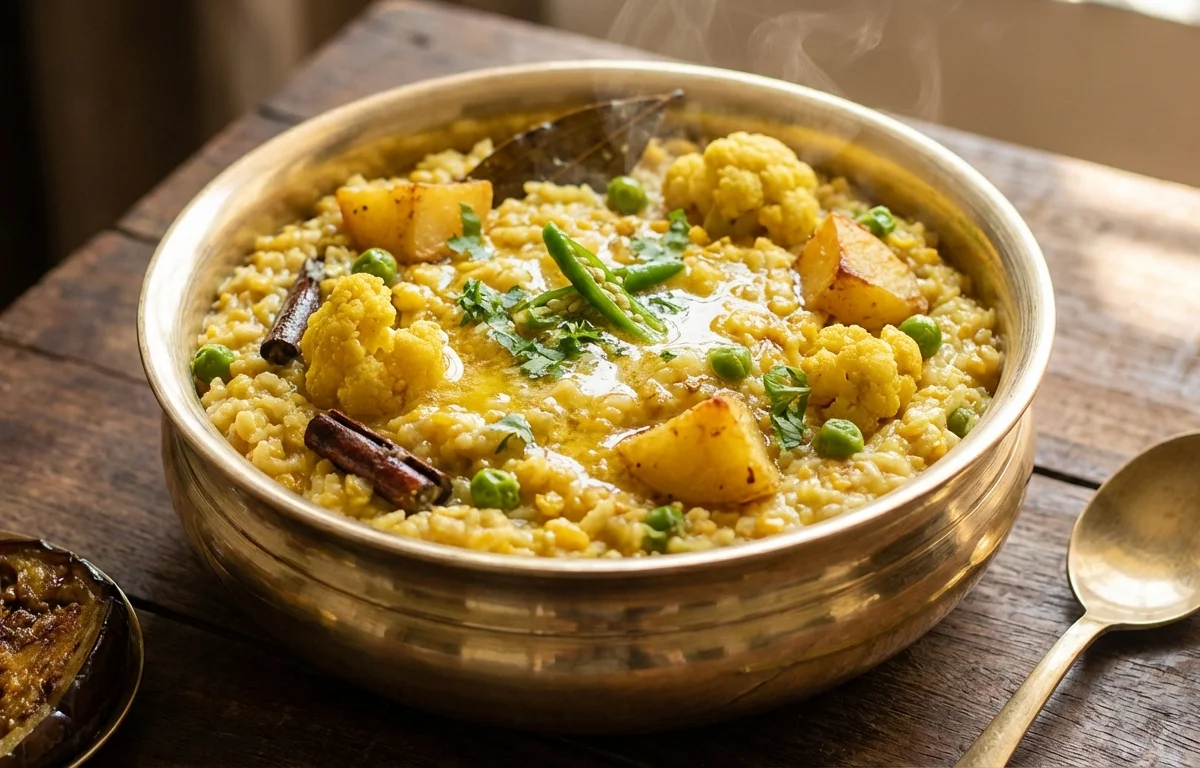
Bhaja Muger Khichuri
A fragrant Bengali one-pot meal made with roasted yellow lentils and aromatic Gobindobhog rice. This comforting khichuri is nutty, flavorful, and a beloved classic for rainy days or festive occasions.
For 4 servings
7 steps. 30 minutes total.
- 1
Step 1
- a.Roast Dal and Prepare Rice
- b.Place a heavy-bottomed pan or kadai over low-medium heat. Add the moong dal and dry roast, stirring continuously for 5-7 minutes until it turns a light golden brown and emits a nutty fragrance. Do not let it burn.
- c.Remove the roasted dal from the pan and set it aside to cool slightly.
- d.In a separate bowl, wash the Gobindobhog rice 2-3 times until the water runs clear. Drain completely and set aside.
- 2
Step 2
- a.Sauté Vegetables
- b.Heat 1 tablespoon of ghee in a 3 or 5-liter pressure cooker over medium heat.
- c.Add the cubed potatoes and cauliflower florets. Sauté for 3-4 minutes until they develop light golden-brown spots.
- d.Remove the vegetables from the cooker with a slotted spoon and keep them aside. This prevents them from getting mushy.
- 3
Step 3
- a.Temper the Spices (Phoron)
- b.In the same pressure cooker, add another tablespoon of ghee.
- c.Once the ghee is hot, add the bay leaves, dried red chilies, cinnamon stick, crushed green cardamom, cloves, and cumin seeds.
- d.Allow the spices to sizzle for about 30-45 seconds until they become aromatic. This is a crucial step for flavor.
- 4
Step 4
- a.Sauté Aromatics and Masala
- b.Add the ginger paste and slit green chilies to the cooker. Sauté for about 1 minute until the raw smell of ginger dissipates.
- c.Lower the heat and add the turmeric powder and roasted cumin powder. Stir for 30 seconds, being careful not to burn the spices.
- 5
Step 5
- a.Combine Ingredients
- b.Add the washed rice and the roasted moong dal to the cooker. Gently sauté for 2 minutes, ensuring each grain is coated with the ghee and spices.
- c.Return the sautéed potatoes and cauliflower to the cooker. Add the green peas, salt, and sugar. Mix everything together gently.
- d.Pour in 5 cups of hot water and give the mixture a final stir to combine everything well.
- 6
Step 6
- a.Pressure Cook the Khichuri
- b.Secure the lid of the pressure cooker. Cook on high heat until you hear the first whistle.
- c.Immediately reduce the heat to low and let it simmer for exactly 5 minutes. Then, turn off the heat.
- d.Allow the pressure to release naturally. Do not force open the lid. This resting time is essential for the grains to absorb steam and cook perfectly.
- 7
Step 7
- a.Finish and Serve
- b.Once the pressure has fully released, carefully open the cooker lid.
- c.Drizzle the final tablespoon of ghee over the hot khichuri. This enhances the aroma and flavor.
- d.Gently fluff the khichuri with a fork. Let it stand for 5 minutes before serving.
- e.Serve hot with traditional accompaniments like Begun Bhaja (fried eggplant), papad, and a side of pickle or chutney.
What to keep in mind.
6 tips from the recipe — small details that make a real difference to the final dish.
- 1The most critical step is dry roasting the moong dal. Do not skip this, as it imparts the signature nutty flavor and aroma to the dish.
- 2Using authentic Gobindobhog rice is highly recommended for its unique fragrance, but Basmati or any short-grain rice can be used as a substitute.
- 3Always use hot water when making khichuri. Adding cold water can slow down the cooking process and affect the texture of the grains.
- 4Letting the pressure release naturally is key to achieving perfectly cooked, separate grains. Quick-releasing the pressure can result in a mushy texture.
- 5For a richer, festive version, you can add a handful of cashews and raisins along with the vegetables.
- 6The consistency can be adjusted. For a softer, more porridge-like khichuri, add an extra half to one cup of hot water.
Adapt it for your goals.
Vegetable Additions
Feel free to add other seasonal vegetables like carrots, green beans, or sweet potatoes. Add them along with the potatoes and cauliflower.
No Onion No Garlic VersionNo Onion No Garlic Version
This recipe is naturally Satvik (no onion, no garlic), making it suitable for religious occasions and festivals.
Stovetop MethodStovetop Method
If you don't have a pressure cooker, you can cook this in a heavy-bottomed pot with a tight-fitting lid. After adding water, bring to a boil, then cover and simmer on low heat for 20-25 minutes, or until the rice and dal are cooked through.
Richer FlavorRicher Flavor
For a more indulgent khichuri, fry 10-12 cashew nuts and a tablespoon of raisins in ghee until golden and add them as a garnish before serving.
Why this is on our healthy list.
Complete Protein Source
The combination of rice (a cereal) and moong dal (a legume) provides all the essential amino acids, making it a complete protein source, which is especially beneficial for vegetarian diets.
Aids Digestion
This khichuri is light on the stomach and easy to digest. The fiber from the dal and vegetables promotes healthy bowel movements and supports overall gut health.
Provides Sustained Energy
Rich in complex carbohydrates from rice and lentils, this dish offers a steady release of energy, keeping you full and energized for longer periods.
Rich in Micronutrients
The use of various spices like turmeric, cumin, and ginger, along with vegetables, provides essential vitamins, minerals, and antioxidants that help boost immunity and fight inflammation.
Frequently asked questions
The most authentic and best-tasting rice for this dish is Gobindobhog, a short-grain aromatic rice from Bengal. Its unique fragrance is key to the traditional flavor. If unavailable, you can use Basmati or any other short-grain rice.