
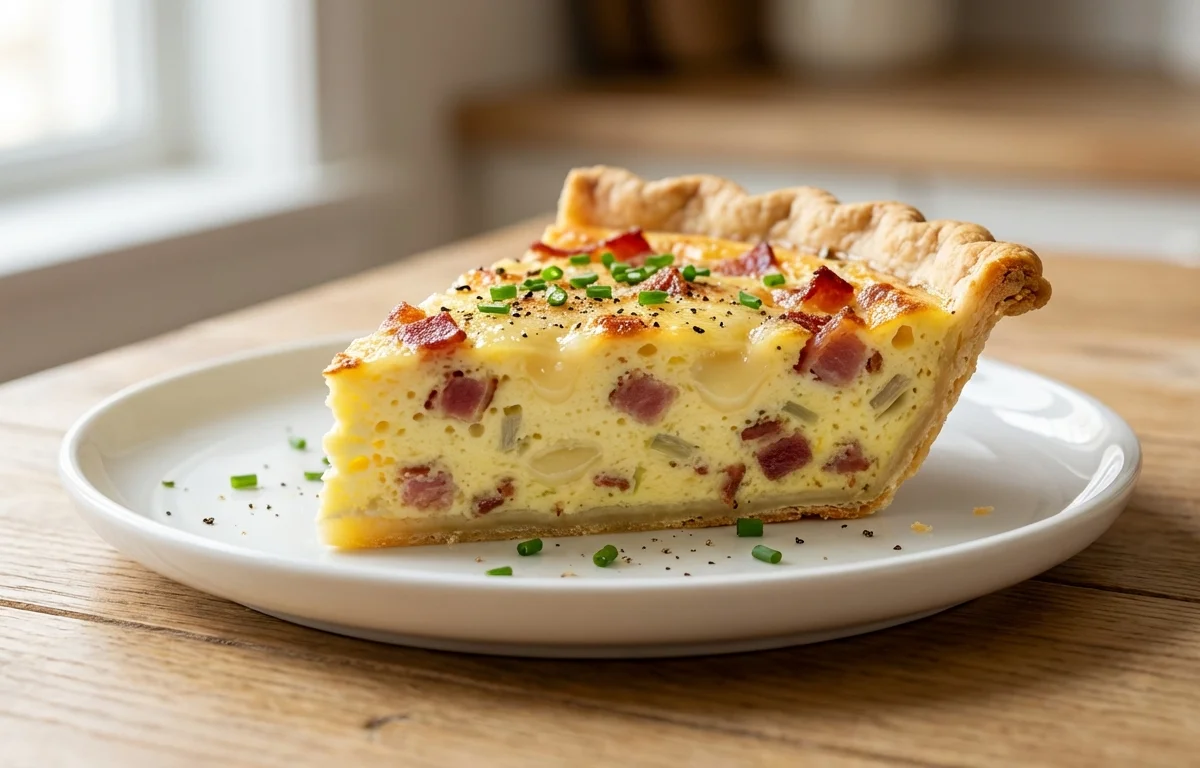
Bacon and Swiss Quiche
A classic Bacon and Swiss Quiche featuring a rich, creamy egg custard, smoky bacon, and nutty Swiss cheese, all baked in a flaky, buttery pie crust. Perfect for brunch, lunch, or a light dinner, this savory tart is a timeless crowd-pleaser.
For 8 servings
8 steps. 55 minutes total.
- 1
Preheat oven to 400°F (200°C)
- a.For a crispier crust, blind bake it first. Press the pie crust into a 9-inch pie plate. Line the crust with parchment paper and fill with pie weights or dried beans. Bake for 15 minutes. Carefully remove the parchment and weights, then bake for another 5-7 minutes, until lightly golden. Set aside and reduce oven temperature to 375°F (190°C).
- 2
While the crust bakes, prepare the filling
- a.Place bacon in a large skillet over medium heat. Cook until crisp, about 8-10 minutes. Use a slotted spoon to transfer the bacon to a paper towel-lined plate to drain. Once cool, crumble it.
- 3
Pour off all but 1 tablespoon of bacon fat from the skillet
- a.Add the finely chopped shallots to the skillet and sauté over medium heat for 2-3 minutes until softened and fragrant. Remove from heat.
- 4
Step 4
- a.In a medium bowl, whisk together the eggs and heavy cream until smooth and well combined. Whisk in the salt, freshly ground black pepper, and ground nutmeg. Be careful not to over-whisk, as this can incorporate too much air.
- 5
Assemble the quiche
- a.Sprinkle the sautéed shallots evenly over the bottom of the pre-baked pie crust. Follow with the crumbled bacon, and then the shredded Swiss cheese, creating even layers.
- 6
Step 6
- a.Carefully and slowly pour the egg custard mixture over the layered ingredients in the pie crust. Place the pie plate on a baking sheet to catch any potential spills.
- 7
Bake at 375°F (190°C) for 35-45 minutes
- a.The quiche is done when the top is golden brown and the center is just set (it should have a slight jiggle). If the crust edges brown too quickly, cover them with a pie shield or aluminum foil.
- 8
Step 8
- a.Remove the quiche from the oven and let it rest on a wire rack for at least 15 minutes before slicing and serving. This allows the custard to set completely, ensuring clean slices.
What to keep in mind.
4 tips from the recipe — small details that make a real difference to the final dish.
- 1For the smoothest custard, ensure your eggs and cream are at room temperature before whisking.
- 2Grate your own Swiss cheese from a block. Pre-shredded cheese contains anti-caking agents that can prevent it from melting as smoothly.
- 3Don't overbake the quiche. A slight wobble in the center is perfect, as it will set fully from residual heat while it rests.
- 4For a lighter version, you can substitute half-and-half for heavy cream, but the resulting custard will be less rich and creamy.
Adapt it for your goals.
Classic Quiche Lorraine
For the most authentic version, use Gruyère cheese instead of Swiss and omit the shallots.
Vegetarian QuicheVegetarian Quiche
Omit the bacon and use 1.5 cups of sautéed vegetables like spinach (well-drained), mushrooms, and bell peppers.
Crustless QuicheCrustless Quiche
For a lower-carb, gluten-free option, pour the filling into a well-greased 9-inch pie dish and bake for 30-35 minutes, or until set.
Herb Infused QuicheHerb-Infused Quiche
Add 2 tablespoons of fresh, finely chopped herbs like chives, parsley, or thyme to the egg mixture for an aromatic boost.
Why this is on our healthy list.
Rich in Protein
The combination of eggs, cheese, and bacon provides a significant amount of high-quality protein, which is essential for muscle repair, immune function, and feeling full.
Source of Calcium
Swiss cheese and heavy cream are good sources of calcium, a mineral vital for maintaining strong bones and teeth, as well as proper nerve and muscle function.
Provides Key Vitamins
Eggs are a natural source of important vitamins like B12, which is crucial for nerve function and red blood cell formation, and Vitamin D, which aids in calcium absorption.
Frequently asked questions
A typical slice of this quiche contains approximately 450-550 calories, depending on the specific ingredients used, such as the type of pie crust and the fat content of the bacon and cream.