
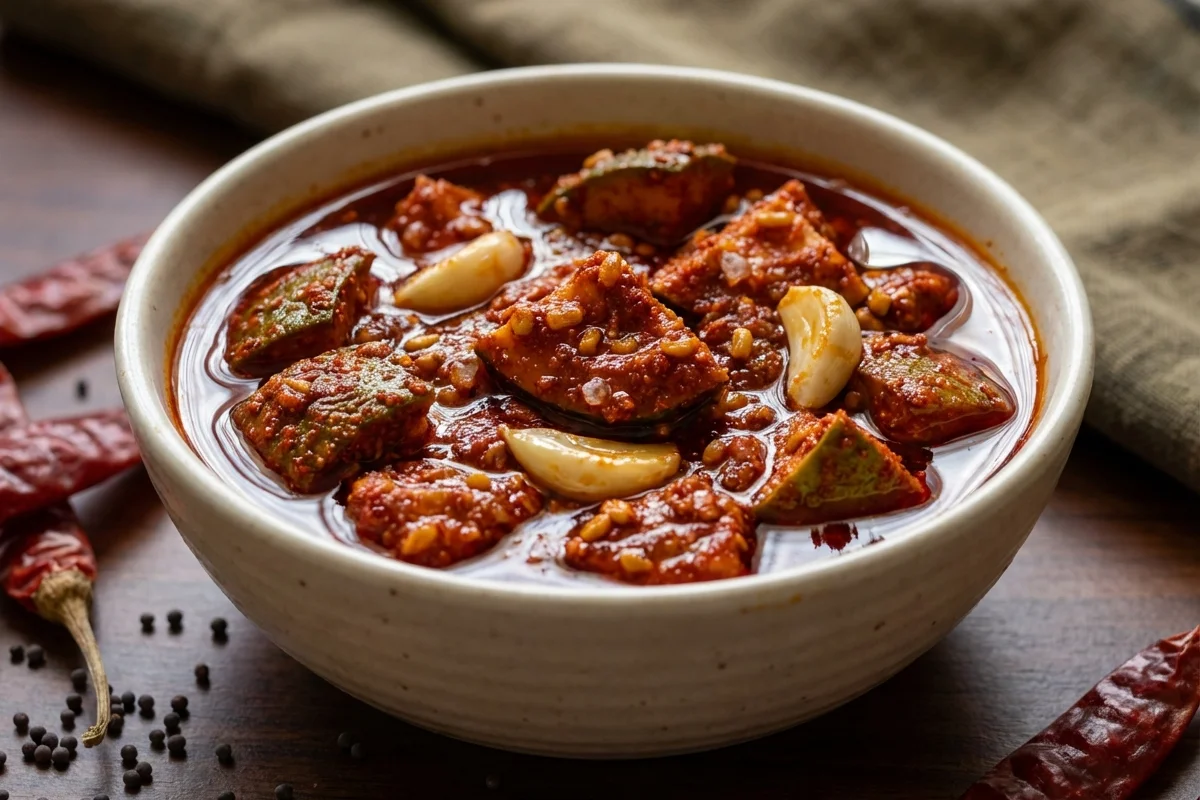
Avakkai Pickle
A fiery and tangy raw mango pickle from Andhra Pradesh. Made with a bold blend of mustard powder, chili, and garlic, this classic 'Avakkai' is the perfect spicy accompaniment to rice and curd.
For 148 servings
7 steps. 5 minutes total.
- 1
Step 1
- a.Prepare the Mangoes (15 minutes)
- b.Wash the raw mangoes thoroughly under running water. Wipe them with a clean, dry kitchen towel until they are completely free of moisture. This is the most critical step to prevent spoilage.
- c.Place the mangoes on a dry cloth and let them air dry for at least an hour to ensure no hidden moisture remains.
- d.Using a heavy-duty, sharp knife, cut the mangoes into 1-inch cubes. Traditionally, the mango is cut along with its hard inner shell (tenka), but the soft seed inside is discarded. Ensure your knife and cutting board are also bone dry.
- 2
Step 2
- a.Mix the Masala (5 minutes)
- b.In a large, non-reactive, and completely dry mixing bowl (glass or steel), combine the mustard powder, red chili powder, powdered rock salt, fenugreek powder, and turmeric powder.
- c.Whisk the dry spices together until they are uniformly mixed.
- 3
Step 3
- a.Combine Mangoes and Spices (5 minutes)
- b.Add the cut mango pieces and the peeled whole garlic cloves to the spice mixture.
- c.Using a dry spoon or clean, dry hands, toss everything together gently but thoroughly. Ensure every single piece of mango is evenly coated with the masala.
- 4
Step 4
- a.Temper and Add Oil (10 minutes)
- b.In a small pan, gently heat the sesame oil over low heat for 2-3 minutes until it is just warm. Do not let it smoke.
- c.Turn off the heat, add the hing to the warm oil, and give it a quick stir. This infuses the oil with its aroma.
- d.Set the oil aside and let it cool down completely to room temperature. Adding hot oil will cook the mangoes and spoil the pickle's texture.
- 5
Step 5
- a.Final Mixing and Bottling (10 minutes)
- b.Once the oil has cooled completely, pour it over the masala-coated mango pieces.
- c.Mix everything very well with a dry ladle until the oil is incorporated and the mixture looks like a thick, luscious paste.
- d.Carefully transfer the pickle into a sterilized, dry glass or ceramic jar (known as a 'jaadi' or 'barni'). Press down gently to pack it in.
- e.Pour any remaining oil from the mixing bowl over the top. The oil layer acts as a natural preservative.
- 6
Step 6
- a.Ferment and Mature (3-5 days)
- b.Cover the mouth of the jar with its lid or tie a clean muslin cloth over it. Do not seal it airtight for the first few days.
- c.Place the jar in a cool, dry corner of your kitchen, away from direct sunlight.
- d.For the next 3 days, open the jar once daily and give the contents a thorough stir from the bottom up using a clean, dry spoon. This ensures even marination.
- e.By day 4 or 5, you will notice the mango pieces have softened slightly, released their juices, and a thick gravy has formed. The oil will float to the top.
- 7
Step 7
- a.Serve and Store (Long-term)
- b.The Avakkai pickle is now ready to be enjoyed. The flavor will continue to deepen and mature over the next few weeks.
- c.Serve with hot rice and ghee, curd rice, idli, or dosa.
- d.Always use a clean, dry spoon to take out the pickle. Ensure a layer of oil is always present on top. If stored correctly, it can last for over a year at room temperature.
What to keep in mind.
5 tips from the recipe — small details that make a real difference to the final dish.
- 1Absolute dryness is non-negotiable. Any trace of moisture on mangoes, utensils, jars, or your hands will lead to mold.
- 2Use high-quality, fresh spices. For the best flavor, buy whole mustard and fenugreek seeds, roast them lightly, and grind them at home.
- 3The salt, chili, and mustard ratio is key to preservation and taste. Stick to the measurements for an authentic and long-lasting pickle.
- 4If the oil level drops below the pickle level after a few weeks, gently warm some more sesame oil, cool it completely, and add it to the jar.
- 5Patience is a virtue. The pickle tastes good after 5 days, but its true, complex flavor develops after a month of maturation.
Adapt it for your goals.
Bellam Avakai (Sweet & Spicy)
Add 100-150g of powdered jaggery to the spice mix for a delicious sweet, spicy, and tangy version.
Vellulli Avakai (Garlicky)Vellulli Avakai (Garlicky)
Double the quantity of garlic cloves to 200g for a more pungent, garlic-forward flavor.
Pappu Avakai (With Chickpeas)Pappu Avakai (With Chickpeas)
Add 100g of raw, dried black chickpeas (kala chana) along with the mango pieces. They will soften in the pickle juices and add a nice texture.
Menthikaya (Fenugreek Dominant)Menthikaya (Fenugreek Dominant)
Increase the fenugreek powder to 50g for a more bitter and distinctly aromatic pickle, a variation popular in Andhra.
Why this is on our healthy list.
Promotes Gut Health
The natural fermentation process involved in making Avakkai encourages the growth of beneficial probiotic bacteria, which can help improve digestion and overall gut health.
Rich in Antioxidants
Spices like turmeric, red chili, and mustard are packed with antioxidants that help fight free radicals in the body. Raw mangoes are also a good source of Vitamin C.
Digestive Aid
Traditional ingredients like hing (asafoetida) and fenugreek are well-known in Ayurveda for their digestive properties, helping to alleviate gas and bloating when consumed in small quantities.
Frequently asked questions
When prepared and stored correctly, ensuring no moisture contamination and a constant layer of oil on top, Avakkai can easily last for more than a year at room temperature.