
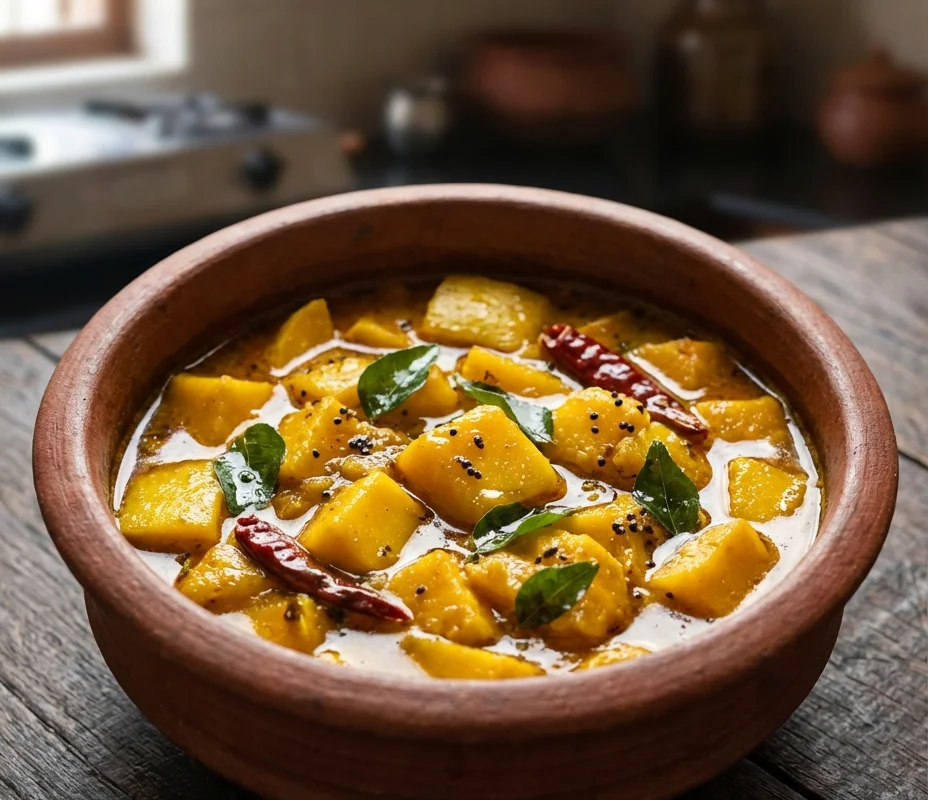
Ambe Upkari
A delightful sweet, spicy, and tangy curry from the Konkani coast, made with ripe mangoes. This seasonal delicacy balances the sweetness of mango and jaggery with the heat of red chilies, creating a truly unique flavor.
For 4 servings
4 steps. 15 minutes total.
- 1
Step 1
- a.Prepare the Mangoes
- b.Wash the mangoes thoroughly under running water.
- c.Peel the skin. If using small, traditional mango varieties, you can leave them whole with a small slit. For larger mangoes, cut them into large, 2-inch chunks, discarding the seed.
- 2
Step 2
- a.Cook the Mango Curry
- b.In a medium-sized pot or kadai, combine the mango pieces, 1 cup of water, turmeric powder, and salt.
- c.Bring the mixture to a gentle boil over medium heat.
- d.Reduce the heat to low, cover the pot, and let it simmer for 7-8 minutes, or until the mangoes are tender but still retain their shape. Avoid overcooking, which can make them mushy.
- e.Add the grated jaggery to the pot. Stir gently until the jaggery dissolves completely.
- f.Continue to simmer for another 2-3 minutes, allowing the mangoes to absorb the sweetness.
- 3
Step 3
- a.Prepare the Tempering (Tadka)
- b.While the curry simmers, heat the coconut oil in a small tadka pan over medium heat.
- c.Once the oil is hot, add the mustard seeds. Wait for them to splutter completely, which should take about 30-40 seconds.
- d.Add the broken dried red chilies and fresh curry leaves. Be careful as the leaves may splutter.
- e.Sauté for about 30 seconds until the chilies darken slightly and the curry leaves become crisp and aromatic. Do not let them burn.
- 4
Step 4
- a.Combine and Serve
- b.Immediately pour the hot tempering over the simmering mango curry. You should hear a satisfying sizzle.
- c.Gently stir to incorporate the tempering into the curry.
- d.Turn off the heat and cover the pot. Let the Ambe Upkari rest for at least 10 minutes before serving to allow the flavors to meld and deepen.
- e.Serve warm with steamed rice or neer dosa.
What to keep in mind.
6 tips from the recipe — small details that make a real difference to the final dish.
- 1Use ripe but firm mangoes. Overripe mangoes will disintegrate and make the curry mushy.
- 2The amount of jaggery depends on the sweetness of your mangoes. Taste the curry before adding all the jaggery and adjust accordingly.
- 3For the most authentic flavor, do not skip the coconut oil in the tempering.
- 4If you prefer a thicker gravy, you can gently mash one or two pieces of cooked mango against the side of the pot.
- 5This curry tastes even better the next day as the flavors have more time to infuse into the mangoes.
- 6Traditionally, small, fibrous local mango varieties ('gont ambo') are used, which are cooked whole and squeezed by hand while eating.
Adapt it for your goals.
With Coconut
For a creamier and richer gravy, add 2-3 tablespoons of freshly grated coconut or 1/4 cup of thin coconut milk towards the end of the cooking process. Simmer for a couple of minutes until well combined.
Spicier KickSpicier Kick
If you prefer more heat, add 1/4 teaspoon of red chili powder along with the turmeric powder. You can also add one or two slit green chilies while cooking the mangoes.
With LentilsWith Lentils
A traditional variation involves adding 1 tablespoon of chana dal (split Bengal gram), soaked for 30 minutes, along with the mangoes. This adds a lovely texture and bite to the curry.
Why this is on our healthy list.
Immunity Booster
Mangoes are an excellent source of Vitamin C, a powerful antioxidant that helps strengthen the immune system and protect the body against infections.
Rich in Antioxidants
Both mangoes and turmeric contain potent antioxidants. Mangoes have polyphenols, while turmeric has curcumin, which help combat oxidative stress and inflammation in the body.
Source of Healthy Fats
The use of coconut oil provides medium-chain triglycerides (MCTs), a type of fat that is easily digested and can be a quick source of energy for the body and brain.
Frequently asked questions
Traditionally, small, fibrous, and tangy-sweet local varieties are used whole. If those aren't available, use ripe but firm mangoes like Badami, Pairi, or even Tommy Atkins. Avoid overly ripe or stringy mangoes as they can turn mushy.